Stopping by Woods on a Snowy Evening: Analysis & Meaning
There are poems that linger in the mind long after the final line, and Robert Frost’s “Stopping by Woods on a Snowy Evening” is one of them. Written in 1922 and published the following year in his Pulitzer Prize-winning collection New Hampshire, this brief four-stanza poem has become one of the most analyzed and beloved works in American literature. What makes it so enduring is the way Frost wraps profound questions about temptation, duty, and mortality inside a deceptively simple winter scene.
Year written: 1922 ·
Year published: 1923 ·
Collection: New Hampshire ·
Meter: Iambic tetrameter ·
Stanzas: 4 ·
Final line repetitions: 2
Quick snapshot
- Tension between contemplative longing and moral duty (SparkNotes poetry analysis)
- Dark woods symbolize temptation or death (eNotes literature study resource)
- Final couplet emphasizes obligation and the journey ahead (SparkNotes themes analysis)
- 4 quatrains in consistent iambic tetrameter (LitCharts educational literature platform)
- Interlocking rhyme scheme: AABA BBCB CCDC DDDD (LitCharts)
- Final line repeated twice for emotional emphasis (LitCharts)
- Duty versus desire for escape (SparkNotes)
- Isolation, solitude, and contemplation (LitCharts)
- Mortality and the journey of life (eNotes)
- Personification (horse with awareness) (eNotes)
- Symbolism (woods, sleep, snow) (SparkNotes)
- Consonance and assonance creating musicality (LitCharts)
Six key facts about the poem, one pattern: Frost built his most famous meditation on duty and desire using the tightest possible formal constraints.
| Fact | Value |
|---|---|
| Full title | “Stopping by Woods on a Snowy Evening” |
| Author | Robert Frost |
| Year written | 1922 (English Literature Education literary analysis site) |
| First published | 1923 in New Hampshire (English Literature Education) |
| Rhyme scheme | AABA BBCB CCDC DDDD (LitCharts) |
| Last line repetition | “And miles to go before I sleep” appears twice in the final stanza (eNotes) |
The interlocking rhyme scheme isn’t decorative — it creates a chain of obligation across stanzas, mirroring the speaker’s own sense of commitments that cannot be shrugged off. Each stanza borrows its second rhyme from the previous one, so no stanza stands alone.
What is the meaning of the poem Stopping by Woods on a Snowy Evening?
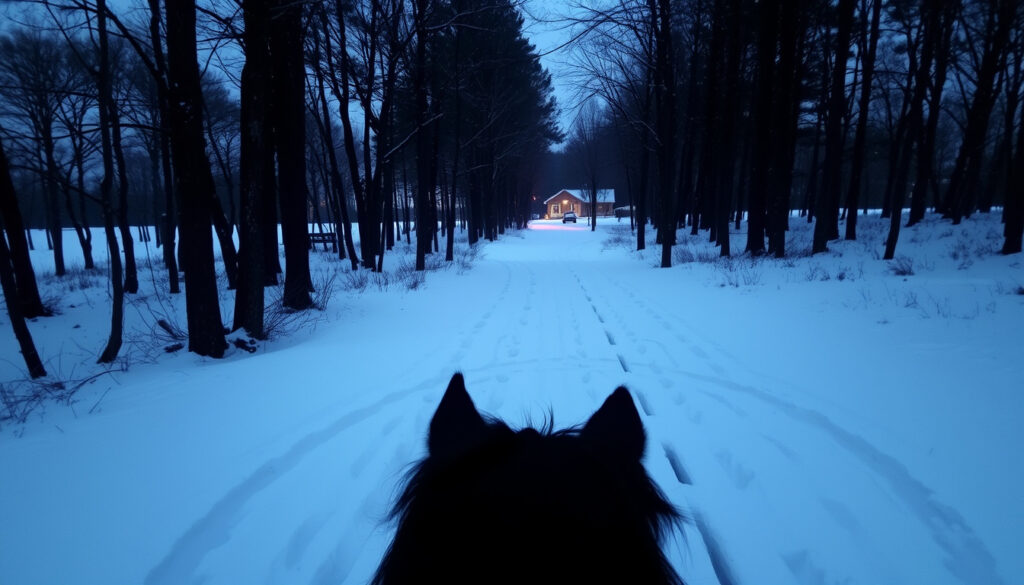
At its narrative surface, the poem is simple: a traveler pauses his horse-drawn sleigh to watch snow fill the woods, then remembers he has promises to keep and moves on. But the interpreter’s task is to ask why the stop matters so much LitCharts educational analysis platform. The traveler is between two worlds — the owned, settled village and the wild, unowned woods — and his pause becomes a miniature moral crisis.
What does the speaker’s stop in the woods symbolize?
- The woods represent temptation toward withdrawal, solitude, or escape from social obligation (SparkNotes literature study guide)
- The “dark and deep” quality also points toward a death wish or longing for final rest (eNotes literature Q&A platform)
- The owner’s absence (“His house is in the village though”) removes social surveillance, making the stop an entirely private choice (LitCharts)
Why does the speaker feel obligated to leave?
- The horse’s harness bells shake, a practical interruption that signals the animal’s unease (LitCharts)
- The speaker remembers “promises to keep” — commonly interpreted as social, familial, or professional duties (SparkNotes themes analysis)
- The final line, repeated, transforms “sleep” from literal rest into a metaphor for death or permanent surrender (eNotes)
The speaker is drawn to the very thing he must resist. The woods are “lovely, dark and deep” — adjectives that merge beauty with danger. Frost forces the reader to feel the pull of the woods as keenly as the speaker does, then watch him tear himself away.
What is the summary of Stopping by Woods on a Snowy Evening?
The poem unfolds across four quatrains, each moving the traveler from observation to decision. Understanding what happens in each stanza reveals how Frost builds tension incrementally.
What happens in each stanza?
- Stanza 1: A traveler pauses his horse beside a frozen lake and snowy woods. He notes that the owner lives in the village and will not see him stopping (LitCharts)
- Stanza 2: The horse shakes its harness bells, questioning the unscheduled stop. This is the only sound beside the “sweep” of wind and falling snow (eNotes)
- Stanza 3: The speaker calls the woods “lovely, dark and deep” and admits their allure — but already the sentence strains toward the turn (PoetryLoversPage poetry analysis archive)
- Stanza 4: The speaker remembers promises and declares he has “miles to go before I sleep” — said twice (eNotes)
How does the poem end?
- The poem ends on a note of resolution, but a costly one: the speaker chooses duty over temptation, yet the repetition of the final line suggests he is still trying to convince himself (LitCharts)
- The rhyme scheme collapses into a single sound (DDDD) in the final stanza, creating a sense of finality (LitCharts)
The pattern: each stanza adds a layer of resistance. The owner won’t know. The horse is confused. The woods are beautiful. But each layer is answered by a stronger pull toward obligation — the shake of bells, the memory of promises, the weight of “miles.”
What is the main message of Stopping by Woods on a Snowy Evening?
The message is not a simple lesson but a tension Frost leaves unresolved. Readers who expect a clear moral will find the poem frustrating; those who accept ambiguity will find it inexhaustible.
Is the poem about death?
- Many critics interpret “sleep” as a metaphor for death and the woods as a temptation toward it (eNotes)
- The poem does not explicitly advocate suicide or death — it uses the woods as a symbolic temptation, not a literal act (SparkNotes)
- Frost himself said the poem came to him in a flash after staying up all night finishing “New Hampshire,” which dampens but does not invalidate the death-reading (English Literature Education)
Does the poem advocate for duty over desire?
- The speaker leaves the woods, which suggests duty wins — but the poem’s sensual language leans toward desire, creating an unresolved tension (SparkNotes)
- The primary message may be the experience of the tension itself: the reader is meant to feel both the pull of the woods and the weight of promises (LitCharts)
Readers who insist the poem is “really about death” miss Frost’s refusal to pin it down. The poem works because the woods could be rest, temptation, death, or simply a beautiful scene. Certainty would ruin it.
What is the deeper meaning of Stopping by Woods?
Beneath the surface narrative, Frost builds a network of symbols that reward close reading. The horse, the sleep, and the repetition each carry interpretive weight.
What does the horse represent?
- The horse represents societal norms and practical concerns — it “asks” why they have stopped without a farmhouse nearby (eNotes)
- The harness bells function as an interruption to reverie and a return to practical reality (YouTube educational video analysis)
- The horse’s confusion mirrors the reader’s own: why stop here, in the cold and dark, with no destination? (LitCharts)
What does “miles to go before I sleep” mean?
- On the literal level: the speaker still has distance to travel before he can rest for the night (eNotes)
- On the metaphorical level: “sleep” signifies death, and “miles to go” means the speaker still has life to live and duties to fulfill (eNotes)
- The repetition of the final line underscores the speaker’s inner conflict and resolve — as if he must tell himself twice to keep going (LitCharts)
Stanza 3: “The woods are lovely, dark and deep, / But I have promises to keep, / And miles to go before I sleep, / And miles to go before I sleep.”
— Robert Frost, “Stopping by Woods on a Snowy Evening” (Poetry Foundation poetry archive and educational resource)
Timeline: Key events in the poem’s history
- 1922 — Frost writes the poem after staying up all night finishing “New Hampshire” (English Literature Education)
- 1923 — Poem published in Frost’s collection New Hampshire (English Literature Education)
- 1924 — Frost wins Pulitzer Prize for Poetry for New Hampshire (Poetry Foundation biographical overview)
- 1960s — The poem becomes one of Frost’s most anthologized and taught works (LitCharts)
Frost reportedly said the poem came to him in a flash after working all night — not as a meditation on death but as a spontaneous response to exhaustion and the dawn.
— Robert Frost (letter, 1923), cited in English Literature Education literary analysis site
Confirmed facts and what remains unclear
Confirmed facts
- The poem is written in iambic tetrameter with a strict interlocking rhyme scheme (LitCharts)
- Frost published it in 1923 as part of New Hampshire (English Literature Education)
- The poem has 4 stanzas of 4 lines each (LitCharts)
- The last line is repeated twice (eNotes)
What’s unclear
- Whether Frost intended the woods to represent death or temptation is not stated explicitly (SparkNotes)
- The exact autobiographical trigger for the poem — Frost’s all-nighter — is debated among scholars (English Literature Education)
- Whether “sleep” means literal rest, death, or both is deliberately ambiguous (eNotes)
youtube.com, facebook.com, ijcrt.org, youtube.com, youtube.com
Frequently asked questions
Is Stopping by Woods on a Snowy Evening about death?
The poem can be read as a meditation on death, with “sleep” symbolizing the final rest. However, Frost never confirmed this interpretation, and many scholars argue the poem is about the tension between duty and desire rather than death itself (SparkNotes).
Why did Robert Frost write Stopping by Woods on a Snowy Evening?
Frost reportedly wrote the poem in a single sitting after staying up all night finishing his collection New Hampshire. He described it as coming to him in a flash, though scholars debate whether the poem carries deeper autobiographical meaning (English Literature Education).
What does “miles to go before I sleep” mean?
On the surface, it means the speaker still has distance to travel before resting. Metaphorically, “miles” represent the obligations of life that remain before the final rest of death. The repetition emphasizes the speaker’s resolve to keep going (eNotes).
How many stanzas are in Stopping by Woods on a Snowy Evening?
The poem has 4 stanzas, each containing 4 lines (quatrains) (LitCharts).
What is the rhyme scheme of the poem?
The rhyme scheme is AABA BBCB CCDC DDDD. Each stanza borrows the “B” or “C” rhyme from the previous stanza, creating an interlocking effect that collapses into the single “D” rhyme of the final stanza (LitCharts).
Is the horse a symbol in the poem?
Yes. The horse’s unease and the shaking of its harness bells symbolize the practical world interrupting the speaker’s reverie. The horse “asks” why they have stopped, representing societal expectations and the demands of everyday life (eNotes).
What does the phrase “lovely, dark and deep” mean?
This line describes the woods and is often treated as the poem’s emotional center. “Lovely, dark and deep” captures the woods’ beauty, mystery, and danger all at once. It expresses the speaker’s attraction to the scene and the temptation to linger (PoetryLoversPage).
Was Stopping by Woods on a Snowy Evening Frost’s most famous poem?
Yes, along with “The Road Not Taken,” it is widely considered Frost’s best-known and most anthologized work. Its popularity stems from its accessible language, musical structure, and open-ended themes (Poetry Foundation).
For readers returning to this poem — maybe for the first time since high school — the real discovery is how much Frost accomplishes in 16 lines. The tension between the lovely woods and the miles ahead never resolves, and that’s the point. For anyone teaching or studying this poem, the clearest takeaway is that the form itself is the argument: the interlocking rhyme scheme, the repeated last line, the collapse into a single sound — these are not decorative choices. They are the engine of the poem’s meaning. For a student preparing an analysis, the most productive question is not “What does the poem mean?” but rather “How does the poem make me feel both the pull of the woods and the weight of the promises?” Answer that, and you’ve understood Frost’s quiet masterpiece.
More related posts
 Best Films on Netflix Ireland Right Now: Top 10 + Picks
 Best Hotels in Dublin City Centre: Top Picks & Guides
 Occupied Territories Bill Ireland: Status, Opponents & Timeline
 When to Prune Roses: Month-by-Month Guide & Timing Tips
 Hotmail Account Sign In: Re et a Forgotten Pa word
 England Women vs India Women: Head-to-Head & Live Stream
 Micro Suction Near Me: Costs, Clinics & Locations in Ireland
 Loans Ireland Bad Credit: Can You Get One? 2025 Guide
