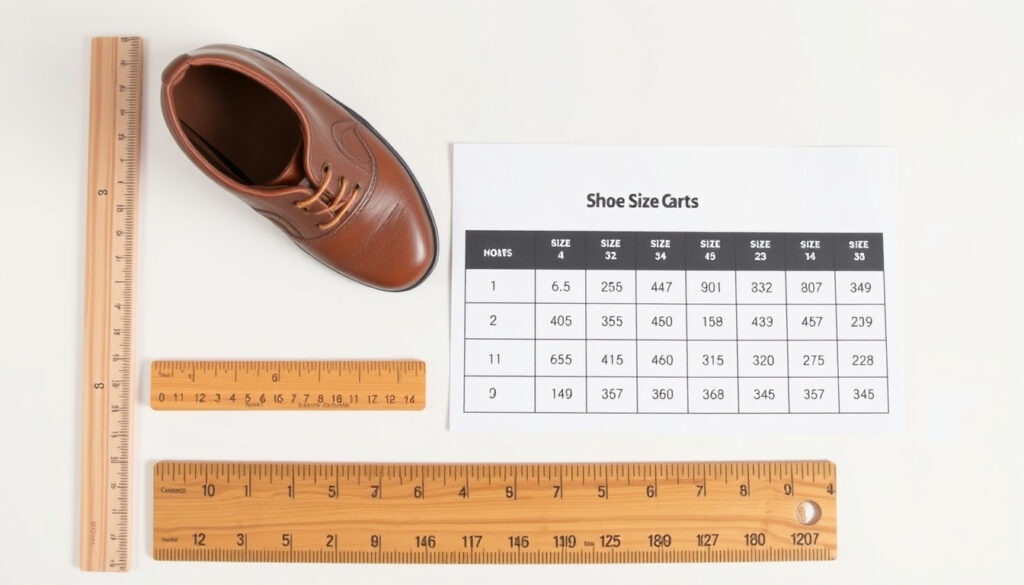
Size 6 Shoes in EU: Conversion Guide for Women, Men, Kids
Anyone who has ever ordered shoes online knows the moment of doubt: a US 6 looks simple until it arrives labeled 36, 37, or 38, because EU sizing is built around the length of the last, not around your US number. This guide sorts out the women’s, men’s, and kids’ conversions — and gives you a practical way to find your EU size without guessing.
US women’s size 6 in EU: 36–37 · US men’s size 6 in EU: 39 · Junior’s US 6 in EU: 38
Quick snapshot
- US women’s 6 typically converts to EU 36–37 (Size.ly (shoe-size chart tool)).
- US men’s 6 typically converts to EU 39 (DSW (U.S. shoe retailer)).
- EU sizing is based on the length of the last, not directly on foot length (ISO/FDIS 19407 (standards draft)).
- Whether an EU 37 fits a US 6 or 7 depends on the brand and the shoe’s last construction (RunRepeat (shoe research site)).
- A nominal size does not guarantee a fixed internal length, because toe allowances, widths, and brand patterns vary. (RunRepeat (shoe research site))
- ISO/TS 19407:2015 first standardized multi-system shoe conversion tables (ISO (global footwear standards body)).
- ISO 19407:2023 later separated adult technical, adult recommended-marking, and children’s tables (ISO 19407:2023, footwear standard). (ISO (global footwear standards body))
- Measure your foot in centimeters before ordering from an EU chart (RunRepeat (shoe research site)).
- Use children’s conversion scales for kids and adult scales for adults. (RunRepeat (shoe research site))
Five conversion points, one pattern: the same US size 6 changes meaning when the context changes from women’s to men’s to children’s.
| Conversion point | Value | Reference |
|---|---|---|
| US women’s 6 in EU | 36–37 | Size.ly (chart tool) |
| US men’s 6 in EU | 39 | DSW (retailer guide) |
| Junior’s US 6 in EU | 38 | Size.ly (chart tool) |
| EU size step | ≈6.67 mm per Paris point | ISO/FDIS 19407 (standards draft) |
| Mondopoint intervals | 5 mm or 7.5 mm | ISO (footwear standard) |
| Recommended first step | Measure foot length in cm | RunRepeat (shoe research site) |
What is the European shoe size equivalent to a US size 6?
Because US sizing splits by gender and age, a single US size 6 does not point to one EU number. Most conversion charts put a women’s 6 at EU 36–37 and a men’s 6 at EU 39; children’s shoes use a separate grading scale entirely (ISO, global footwear standards body).
- Women: US 6 → EU 36–37.
- Men: US 6 → EU 39.
- Toddlers: US kids’ 6 → EU 23.5; juniors: US kids’ 6 → EU 38 in typical commercial charts.
US size 6 can mean a toddler’s foot, a woman’s foot, or a man’s foot. That is why the same US number converts to EU 23.5, EU 37, or EU 39 depending on who is wearing the shoe.
The implication: if you shop with only the US number, you are missing half the conversion. The EU number only means something once you know whose foot is on the other side.
Is a 37 a 6 or 7?
EU 37 sits in the overlap between US 6 and US 7 on women’s charts and near US 4.5–5 on men’s charts. The reason is simple: one US size can correspond to more than one EU size, especially once gender scales are involved (RunRepeat, shoe research site).
- Women: EU 37 → US 6 or 6.5 in most brands.
- Men: EU 37 → US 4.5 or 5.
- Unisex catch: the same last can be labeled women’s 6, women’s 7, or men’s 5 depending on the chart.
What this means: a woman’s 6 and a man’s 7 share plenty of EU sizing space. The brand’s last is the tiebreaker.
Is 38 a UK size 6?
UK sizing is a separate scale from EU sizing, even though both use numbers. On a women’s chart, UK 6 usually maps to EU 39; on a men’s chart, UK 6 maps to EU 40. An EU 38, in turn, is closer to a UK women’s 5.5 or a junior’s size rather than a straight UK 6 (Size.ly (shoe-size chart tool)).
- UK women’s 6 → EU 39.
- UK men’s 6 → EU 40.
- EU 38 → closer to UK women’s 5.5–6 depending on fit.
The catch: UK and EU sizes look similar, but they do not move in steps of one. A 38 from one system can be a completely different fit in the other.
What size is 37 in female shoes?
In women’s shoes, EU 37 corresponds to US 6–6.5; in men’s shoes it corresponds to US 4.5–5. Since the EU number is unisex, the same pair in EU 37 can be labeled differently on US women’s and men’s charts (DSW (U.S. shoe retailer)).
- EU 37 women’s → US 6–6.5.
- EU 37 men’s → US 4.5–5.
- EU 37 in Zara may fit like a standard EU 37 or like a smaller EU 36.5, depending on the shoe’s last and heel shape.
An EU 37 shoe is designed around a last length, not a US gender number. For a woman that often lands on US 6–6.5; for a man it lands closer to US 4.5–5. The shoe did not change — the label did.
What this means: EU 37 is not a gender-specific size. In women’s shoes it reads as 6–6.5; in men’s shoes it reads much smaller.
What is the equivalent of an 8-number shoe in centimeters?
The phrase “8-number shoe” is not a measurement; it is a label. In practice, you convert by foot length: a US women’s 6 is around 22 cm, a US men’s 6 is around 24 cm, and EU 37 is often listed at 23.5 cm. Measuring the foot directly is more reliable than converting a nominal US size (RunRepeat, shoe research site).
- US women’s 6 → roughly 22 cm.
- US men’s 6 → roughly 24 cm.
- EU 37 → roughly 23.5 cm in common charts.
Children’s sizing is so different that adult US 6 does not apply to a 7-year-old boy; kids’ charts use their own grading scale, usually closer to EU 30–32 for that age.
The takeaway: an 8, a 6, or a 37 is just a label. Centimeters are the only universal language in shoe sizing.
Three tracks, one pattern: the same numerical size 6 refers to different feet, so the EU equivalent changes with the wearer.
| Wearer | US size | Typical EU size | Foot length range |
|---|---|---|---|
| Adult woman | US women’s 6 | 36–37 | ~22 cm |
| Adult man | US men’s 6 | 39 | ~24 cm |
| Toddler | US kids’ 6 | 23.5 | ~13.5 cm |
| Junior | US kids’ 6 | 38 | ~24 cm |
The pattern: the same number, three different feet, three different EU results. That is not a chart error — that is how the systems are designed.
Four sizing systems, one pattern: each system uses length differently, which is why the same foot can be a 6 in one country and a 37 in another.
| System | What it measures | Grading interval |
|---|---|---|
| EU (Paris points) | Last length | ≈6.67 mm per point |
| Mondopoint | Foot length in mm | 5 mm or 7.5 mm |
| US adult | Length grading on adult scale | Varies by brand |
| US children’s | Separate age-based grading scale | Separate from adult scale |
| UK | Length grading with UK offset | See EU/US conversion charts |
| ISO 19407:2023 | Connects 7 international systems | Adult and children’s tables separated |
The takeaway: the EU system was never built to tell you your US size; it was built around the length of the last. That is why brand-specific sizing exists.
How to find your EU size in five steps
One measurement, one conversion — this is the process that fixes the “is a 37 a 6 or 7?” problem.
- Stand with your heel against a wall and mark the longest toe.
- Measure the length in centimeters from the heel mark to the toe mark.
- Find that cm value in a EU or Mondopoint chart rather than converting from a US number.
- Check the brand’s size guide for width and last notes.
- If your foot sits between two sizes, choose based on the shoe’s intended fit — closed shoes can use a bit more room.
Why this matters: once you work in centimeters, the 37/6 confusion disappears. You are no longer converting a label; you are matching a foot to a shoe.
Timeline: how sizing standards caught up
- — ISO/TS 19407:2015 publishes conversion tables across major systems (ISO, global footwear standards body).
- — ISO 19407:2023 supersedes the technical spec and separates adult technical, adult recommended-marking, and children’s tables (ISO 19407:2023 (footwear standard)).
- Today — EU commercial size labels still build from the last’s length, so the same number can fit differently across brands.
The implication: standards are getting better at separating adult and children’s conversions, but the shoe on your foot is still made on a last that differs by brand.
Confirmed vs. unclear: what to trust when buying
Confirmed facts
- US women’s 6 = EU 36 or 37 in most charts (Size.ly (shoe-size chart tool)).
- US men’s 6 = EU 39 in most charts (DSW (U.S. shoe retailer)).
- EU sizing uses one unisex scale; US gender scales break it into different numbers (ISO (global footwear standards body)).
What’s unclear
- Whether EU 37 fits like a US 6 or 7 depends on the brand and the shoe’s last (RunRepeat (shoe research site)).
- The exact cm length for a size varies by manufacturer (RunRepeat, shoe research site).
- A 38 on a UK label and a 38 on an EU label are not interchangeable (Size.ly, shoe-size chart tool).
What the standards actually say
European shoe sizing is based on Paris points, with one size interval traditionally equal to approximately 6.67 mm.
— International Organization for Standardization, global footwear standards body
A nominal shoe size does not guarantee identical internal length because lasts, toe allowances, widths, and brand patterns vary.
— RunRepeat, shoe research and testing site
Trust the measurement, not the number.
The takeaway
EU sizing is a unisex scale built from last length, and US size 6 crosses three different worlds. For a woman, size 6 usually means EU 36 or 37; for a man it usually means EU 39; for a small child it can mean EU 23.5 or 38 depending on the grading scale. For anyone buying shoes online in Europe, the decision is clear: measure your foot in centimeters and compare it with the brand’s own chart, or you will keep asking “is a 37 a 6 or 7?” — and getting a different answer each time.
Related reading
- UK Size 9 in EU: Complete Shoe Size Conversion Guide
- Shoe Stores Near Me: Irish Favorites, Top Brands & Foot Health
Frequently asked questions
What size is EU 37 in US children’s shoes?
Children’s sizing is a separate scale, so EU 37 on a children’s chart will not match EU 37 on a women’s chart. Measure the child’s foot in cm and use a kids’ conversion table.
Do EU shoe sizes run the same for men and women?
Yes, EU numbers are unisex: the same EU 37 describes a similar last length regardless of gender, but the corresponding US size differs — around women’s 6–6.5 versus men’s 4.5–5.
Is a US size 6 considered small in Europe?
A women’s US 6 is on the smaller-to-middle end of the adult women’s range; a men’s US 6 is a small adult men’s size; a child’s US 6 is a toddler size.
How does Zara’s shoe sizing compare to standard EU sizes?
Zara uses EU numeric sizing, but fit is still determined by the last. Shoppers who normally wear EU 37 may need EU 38 in a pointed or narrow Zara shoe; compare the cm measurement for the specific style.
What is the best way to measure my foot for EU size 6?
Stand with your heel against a wall, mark the longest toe, and measure the distance in centimeters. Then compare that cm value with the brand’s EU chart.
Can I rely on a conversion chart for buying EU 37 shoes online?
Conversion charts are a starting point, not a guarantee. Brand and last variation mean the same EU 37 can fit like a US 6 or a US 7 depending on the shoe.
Why do some brands list size 6 as EU 36 and others as EU 37?
Because each brand builds shoes on a different last, and one US size can correspond to more than one EU size. The cm measurement is the reliable constant.
More related posts
 The Port House Dublin: Basque Pintxos, Tapas & Wine Guide
 Barron Trump Height Disease: Facts, Rumors, and Truth
 From Dusk Till Dawn: Cast, Plot, and Behind the Scenes
 Charlie Kirk South Park Episode Removed: Why & What Happened
 My Self Service Login: Complete Guide for HSE Staff
 Bank of Ireland Blanchardstown: Phone, Address, Hours Guide
 Steven Bartlett Net Worth 2025: How Rich Is the Dragons’ Den Star?
 TV Listings Tonight Ireland: RTÉ, Virgin Media Guide
