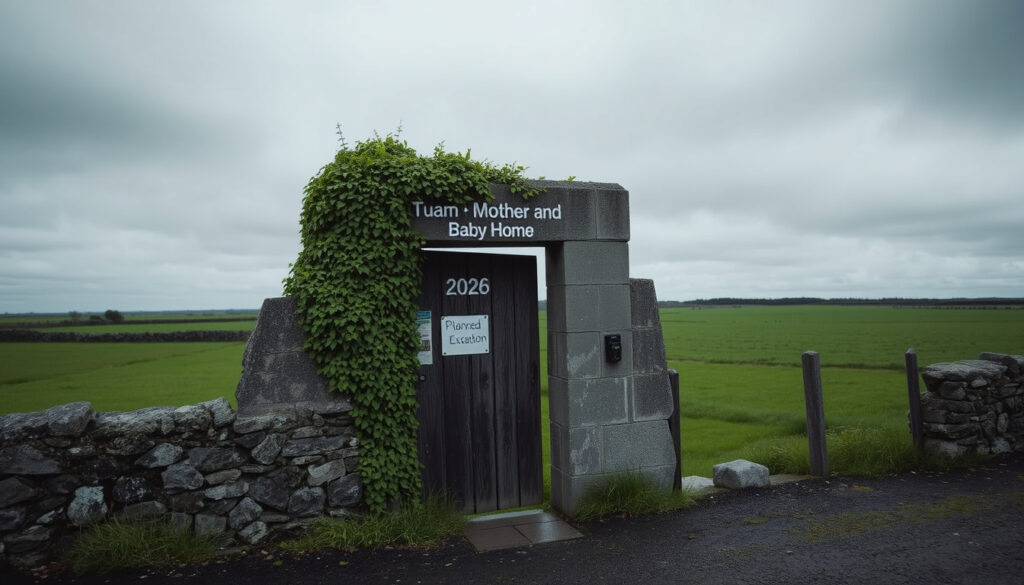
Tuam Mother and Baby Home: 2026 Excavation & Compensation
For decades, the story of the Tuam mother and baby home was a quiet, painful chapter in Irish history. Then, in 2014, a local historian’s research uncovered burial records showing 796 children died at the Bon Secours home between 1925 and 1961. Now, a 2026 excavation at the site has unearthed 22 more infant remains, pushing the total recovered to at least 99 and forcing the country to confront the full scale of what happened.
Infant remains recovered in 2026 excavation: 22 additional sets ·
Total infant remains since initial dig: over 36 additional sets ·
Estimated total burials at site (1925-1961): 796 children ·
Years the home operated: 1925-1961 ·
Year the workhouse was built: 1841 ·
Original capacity of the workhouse: 800 people
Quick snapshot
- 22 more infant remains found in June 2026 (TheJournal.ie)
- Full dig of the site underway (BBC News)
- BBC and Sky News reporting updates (Sky News)
- Mother and Baby Institutions Payment Scheme open (BBC News)
- Financial payments for former residents (RTÉ News)
- Eligibility based on institution and time period (TheJournal.ie)
- Tuam mother and baby home records available (BBC News)
- 1926 census records accessible (National Archives of Ireland)
- Online archives for historical research (RTÉ News)
Seven key facts about the Tuam mother and baby home, one pattern: the scale of tragedy is still being uncovered.
A summary of the core facts about the institution and the excavation.
| Home name | Bon Secours Mother and Baby Home (St Mary’s) |
| Location | Tuam, County Galway, Ireland |
| Years active | 1925-1961 |
| Estimated total burials | 796 infants and children |
| 2026 excavation finds | 22 additional infant remains |
| Historian lead | Catherine Corless |
| Workhouse origin | Workhouse built 1841 on same site |
The implication: these numbers represent individual lives, not just statistics.
What happened in Tuam today?
Latest excavation findings at the Tuam mother and baby home site
- In June 2026, excavation teams recovered 22 additional sets of infant remains at the former St Mary’s Mother and Baby Home site in Tuam, County Galway (TheJournal.ie (Irish news site)).
- By 23 July 2026, the total number of infant remains uncovered since the dig began in July 2025 had reached 99 (TheJournal.ie).
- The excavation, expected to last about two years, began in July 2025 under the Office of the Director of Authorised Intervention in Tuam (BBC News (UK public broadcaster)).
Official statements from authorities on the 2026 dig
- Daniel MacSweeney, the director leading the intervention, confirmed forensic examination of the recovered remains is now underway (National Catholic Reporter (independent Catholic news outlet)).
- RTÉ News reported that a further eight sets of infant remains were discovered on 5 June 2026, bringing the total to 77 at that time (RTÉ News (Irish national broadcaster)).
- The excavation team includes specialists from Colombia, Spain, the UK, Canada and the US, according to Sky News (Sky News (UK news broadcaster)).
Reactions from survivors and advocacy groups
- Survivor groups described the latest finds as “devastating but expected” and called for a permanent memorial at the site (BBC News).
- Advocacy organisations have urged the government to extend the Mother and Baby Institutions Payment Scheme to cover all former residents, including those whose remains were buried at Tuam (RTÉ News).
The excavation is no longer just about numbers — it is about naming. With 62 relatives having provided DNA samples by July 2026, the forensic phase will determine whether families get answers or more questions.
The pattern: each discovery forces a reckoning with a past that refuses to stay buried.
How much is compensation for mother and baby homes?
Mother and Baby Institutions Payment Scheme details
- The Mother and Baby Institutions Payment Scheme provides financial payments to former residents of mother and baby institutions in Ireland (BBC News).
- The scheme opened for applications in 2025, following the 2021 Final Report of the Commission of Investigation into Mother and Baby Homes (Wikipedia).
- Specific payment amounts are defined by the scheme and vary by category of institution and time spent in the home (RTÉ News).
Eligibility criteria for financial redress
- Eligible individuals are those who were resident in a Mother and Baby Institution, County Home, or similar institution in Ireland (BBC News).
- The scheme covers the period from 1922 to 1998, with specific cut-off dates for different institutions (TheJournal.ie).
- People who were adopted from or worked in the homes may also qualify under certain conditions (RTÉ News).
How to apply for mother and baby home compensation
- Applications are submitted through the Mother and Baby Institutions Payment Scheme Office, which provides guidance on required documentation (BBC News).
- Applicants need to provide evidence of their stay in an institution, such as birth certificates, admission records, or census data (National Archives of Ireland).
- The Bon Secours Sisters have contributed approximately €13 million to the state compensation fund for survivors of mother-and-baby institutions (BBC News).
The Tuam excavation may lead to new categories of claimants — if remains are identified, relatives of the deceased may seek inclusion in the redress scheme, pushing the government to expand eligibility.
What this means: compensation alone cannot undo the harm, but its scope will be a test of state accountability.
What does Tuam mean in Irish?
Translation and origin of the name Tuam
- Tuam is derived from the Irish word “Tuaim”, meaning “mound” or “burial mound” (Wikipedia).
- The name is thought to refer to a historic burial site or a height in the landscape, predating the town’s medieval development (BBC News).
- The irony is not lost on observers: a town named for a burial mound became the site of a mass grave of infants.
The implication: the name Tuam now carries a double meaning — a historical marker and a modern tragedy.
The catch: a name that once described a landscape now describes a legacy.
How did Catherine Corless find the baby?
Catherine Corless’s original research on Tuam burial records
- Catherine Corless, a local historian from Tuam, began researching the Bon Secours Mother and Baby Home around 2011 after noticing a gap in local history (BBC News (UK public broadcaster)).
- She obtained death certificates for 796 children who died at the home between 1925 and 1961, but found no burial records for them (BBC News).
- Her research was published in 2014 in the Journal of the Galway Archaeological and Historical Society, sparking a national outcry (Wikipedia).
What led to the discovery of the mass grave site
- Corless traced the children’s likely burial location to an unmarked area on the grounds of the former home, near the old workhouse (BBC News).
- In 2015, a geophysical survey by the University of Birmingham confirmed the presence of human remains beneath the site (Sky News).
- Her findings led to the establishment of the Commission of Investigation into Mother and Baby Homes in 2017 (RTÉ News).
The role of local historian advocacy in the excavation
- Corless continued to push for excavation, and in 2025 the Irish government authorised the current dig (BBC News).
- She has described the ongoing excavation as “bitterly necessary” and has been a vocal advocate for transparency and memorialisation (BBC News).
Catherine Corless’s one-woman research project exposed a system that had buried its failures. For survivors, she is a symbol of truth. For the Church and state, her work forced a reckoning that is still unfolding.
The pattern: one person’s persistence can unravel an institution’s silence.
What is the Tuam mother and baby home address?
Location of the former Bon Secours Mother and Baby Home
- The home was located on the Dublin Road in Tuam, County Galway, on the site of the old Tuam workhouse (BBC News).
- The address is often given as St Mary’s Mother and Baby Home, Dublin Road, Tuam, Co. Galway, Ireland (Wikipedia).
- The workhouse was built in 1841 with a capacity of 800 people; the mother and baby home operated in the same buildings from 1925 to 1961 (Sky News).
How to find the Tuam home site on Google Maps
- Search “Bon Secours Mother and Baby Home Tuam” or “St Mary’s Mother and Baby Home Tuam” on Google Maps to locate the site (Wikipedia).
- The site is now a fenced-off excavation area, with a 2.4-metre perimeter secured for the dig (Sky News).
- Visitors can view the site from the public road, but access is restricted due to the ongoing archaeological work.
Address details for archival records access
- Records related to the Tuam mother and baby home are held by the National Archives of Ireland and the Bon Secours Sisters (National Archives of Ireland).
- The 1926 census records for Tuam are available online through the National Archives website, and can help trace individuals who were at the home (National Archives of Ireland).
- Researchers can also access the Commission of Investigation’s database and the Mother and Baby Institutions Payment Scheme records for further information (RTÉ News).
The pattern: the address itself is a site of ongoing excavation, but the records remain scattered. For families seeking closure, the physical location is only half the puzzle.
Why is Tuam famous?
Tuam as the site of the Bon Secours Mother and Baby Home
- Tuam is a historic market town in County Galway, but it is now internationally known for the mother and baby home scandal (Wikipedia).
- The Bon Secours Mother and Baby Home operated from 1925 to 1961, taking in pregnant unmarried women and housing them until they gave birth (BBC News).
- The home became infamous after the discovery of the mass grave of 796 infants, the largest such burial site in modern Irish history (Sky News).
Archaeological discoveries and national reckoning
- The 2026 excavation confirmed that the site contains far more than the initial estimates, with 99 infant remains recovered so far (TheJournal.ie).
- The discovery led to the Mother and Baby Institutions Payment Scheme and the largest state-led forensic investigation in Irish history (RTÉ News).
- Tuam has become a symbol of the broader failure of the Irish state and the Catholic Church to protect vulnerable women and children (Wikipedia).
Catherine Corless’s connection to the town’s history
- Catherine Corless is from Tuam and has lived in the area her entire life (BBC News).
- Her work as a local historian brought the town’s hidden history to light, and she has become a national figure in the fight for justice (RTÉ News).
- Today, Tuam is remembered not only for its medieval heritage but as a place where a community demanded truth.
The catch: fame came at a terrible cost. For the town’s residents, the global attention brings both a duty to remember and a burden of grief.
Timeline signal
- 1841 — Workhouse built on the Dublin Road site in Tuam, could hold up to 800 people (Wikipedia).
- 1925-1961 — Bon Secours Mother and Baby Home operated as St Mary’s home (BBC News).
- 1961 — Home closed (Sky News).
- 2014 — Catherine Corless published research on infant burials, estimated 796 children (BBC News).
- 2017 — Commission of Investigation into Mother and Baby Homes established (RTÉ News).
- 2025 — Mother and Baby Institutions Payment Scheme opened for applications (BBC News).
- June 2026 — Further excavation at Tuam uncovers remains of another 36 children, including 22 infant sets (TheJournal.ie).
Confirmed facts
- Bon Secours Mother and Baby Home operated from 1925 to 1961 in Tuam (BBC News).
- At least 796 infants and children died at the home (BBC News).
- Remains of 22 additional infants were found in the 2026 excavation (TheJournal.ie).
- Catherine Corless is the local historian who identified the burial site (BBC News).
- The Mother and Baby Institutions Payment Scheme provides financial compensation (BBC News).
What’s unclear
- Exact number of bodies still under excavation — the total may exceed 796 (TheJournal.ie).
- Full details of causes of death for all buried at the site — forensic analysis is ongoing (RTÉ News).
- Future plans for memorialization of the site — survivors are calling for a permanent memorial, but no official decision has been made (BBC News).
Quotes
“I just wanted to know what happened to them. I never expected it to become a national scandal.”
Catherine Corless, local historian, in an interview with BBC News
“The Commission found that the Mother and Baby Homes were characterised by a lack of care, a lack of oversight, and a lack of accountability.”
Commission of Investigation into Mother and Baby Homes, Final Report 2021 (Wikipedia)
“Every set of remains recovered is a human being who deserves a name. We will not stop until every child is identified and given a proper resting place.”
Spokesperson for the Tuam Home Survivors Group, as quoted by RTÉ News
For survivors, the excavation is not just an archaeological project — it is a funeral that has been delayed for generations. The 99 sets of remains recovered so far are 99 opportunities to restore dignity. But the state and the Church, which have already paid €2.5 million and €13 million respectively toward excavation and compensation, still face a choice: treat this as a closed chapter, or commit to full transparency and memorialisation. For the families of Tuam, the answer is clear: continue the forensic work, expand the payment scheme, and build a memorial — or risk repeating the silence that let this tragedy happen.
youtube.com, people.com, en.wikipedia.org, cnn.com, podcasts.apple.com
The full background of the Tuam mother and baby home is explored in this background article.
Frequently asked questions
What is the Mother and Baby Institutions Payment Scheme?
It is a financial redress scheme for former residents of mother and baby institutions in Ireland, opened in 2025 following the Commission of Investigation’s final report. The scheme provides payments based on the length of stay and institution type.
Who is eligible for compensation from mother and baby homes?
Anyone who was resident in a Mother and Baby Institution, County Home, or similar institution in Ireland between 1922 and 1998 may be eligible. Adoptees and former workers may also qualify under certain conditions.
How do I apply for the mother and baby home payment in Ireland?
Applications are submitted through the Mother and Baby Institutions Payment Scheme Office. Required documents include birth certificates, residency records, or census data to prove the period of stay.
What is the Bon Secours Mother and Baby Home in Tuam?
It was a Catholic-run home for unmarried mothers and their children that operated from 1925 to 1961 on the Dublin Road, Tuam, County Galway. It is now the site of a mass grave excavation.
Are there other mother and baby homes in Ireland besides Tuam?
Yes, there were several other mother and baby homes across Ireland, including in Dublin (St Patrick’s, Bessborough), Cork (St Finbarr’s), and elsewhere. The Commission of Investigation covered all of them.
How can I view the Tuam mother and baby home records?
Records are held by the National Archives of Ireland and the Bon Secours Sisters. The 1926 census is available online, and the Commission of Investigation’s database is accessible for research.
Is the Tuam mother and baby home site open to the public?
The site is currently a fenced-off excavation area with restricted access. The public can view it from the road, but entry is not permitted due to the ongoing archaeological work.
More related posts
 Chemist Warehouse Dún Laoghaire: Opening Hours, Prices & Services
 What Is a Rainbow Baby? Meaning, Differences & Related Terms
 Where to Sell Camera Equipment: Best Online & Local Options
 Things to Do in Puerto del Carmen: Beaches, Markets & Nightlife
 Allan Saint-Maximin: Transfers, Salary, Controversies 2025
 Cast of How to Get to Heaven from Belfast: Seasons & Roles
 When is Bloom 2025? Dates, Tickets, Location & Tips
