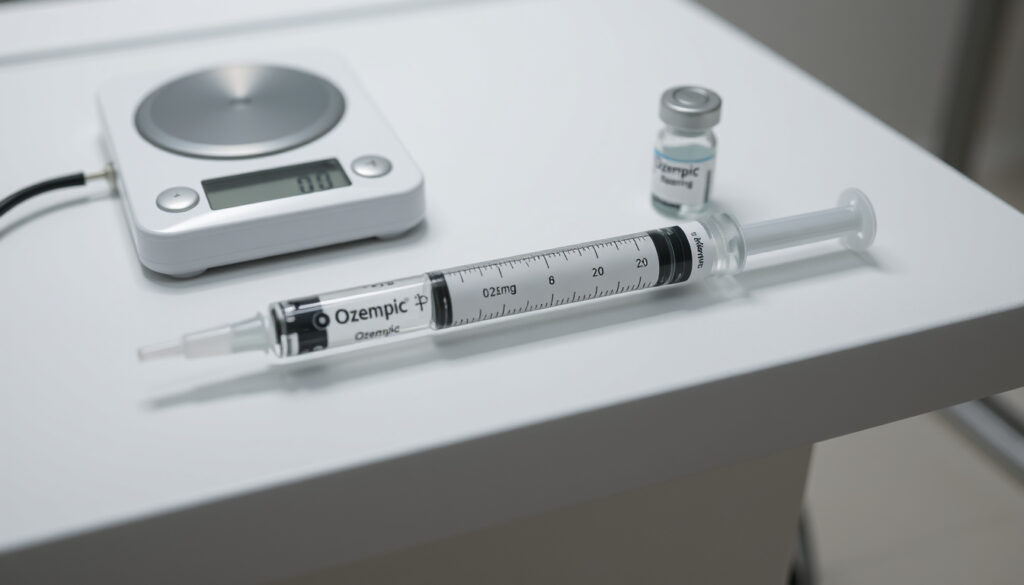
Ozempic Dosing for Weight Loss: 0.25 mg to 2.0 mg
If you’re reading this, you’ve probably heard that Ozempic can lead to significant weight loss — but navigating the dose schedule safely is the real trick. Starting at 0.25 mg once weekly may feel like a drop in the bucket, but that gradual climb is what keeps nausea at bay while your body adapts to semaglutide. Based on FDA prescribing information and clinical trial data, here’s how to follow the dose ladder from 0.25 mg up to 2.0 mg, and what weight loss results you can realistically expect at each step.
Starting dose: 0.25 mg once weekly for 4 weeks ·
Maintenance dose for weight loss: 1.0 mg once weekly (average 10 lb / 4.5 kg loss) ·
Maximum approved dose: 2.0 mg once weekly ·
Dose escalation schedule: Every 4 weeks under medical supervision ·
Average weight loss at 1.0 mg (68 weeks): 14.9% of body weight (STEP 1 trial)
Quick snapshot
- Ozempic starts at 0.25 mg for 4 weeks (FDA Prescribing Information (U.S. drug regulator))
- Maximum dose is 2.0 mg once weekly (FDA Prescribing Information)
- Patients on 1.0 mg lost average 10 lb (4.5 kg) in clinical trials (NCBI Clinical Review (medical research database))
- Exact weight loss varies: individual adherence, diet, exercise, metabolism all play a role.
- Whether 0.5 mg alone is effective for weight loss is contested; clinical data favors 1.0 mg.
- Long-term weight maintenance after stopping Ozempic is not fully documented beyond 68 weeks.
- Weeks 1–4: 0.25 mg – body acclimates, minimal weight loss.
- Weeks 5–8: 0.5 mg – appetite suppression begins, early weight loss may appear.
- Week 9 onward: 1.0 mg – therapeutic dose for weight loss, maximum effect over 6–12 months.
- After week 16: Optional increase to 2.0 mg if additional effect needed.
- Monitor side effects (GI, pancreas, kidney) with each dose increase – consult your physician regularly.
- Consider lifestyle interventions (diet, exercise) to maximize weight loss, as shown in STEP trials.
- If reaching plateau at 1.0 mg, discuss with doctor whether 2.0 mg is appropriate.
Six key parameters define the Ozempic escalation protocol. Here is the approved stepwise progression:
| Parameter | Value |
|---|---|
| Starting dose | 0.25 mg once weekly (FDA label) |
| After 4 weeks | Increase to 0.5 mg (FDA label) |
| After 8 weeks | Increase to 1.0 mg (if needed) (FDA label) |
| Maximum dose | 2.0 mg once weekly (FDA label) |
| Average weight loss (1.0 mg, 68 weeks) | 4.5 kg (10 lb) (NCBI clinical review) |
| Weight loss in 3 months | Variable, typically 3–6 kg (6.6–13.2 lb) |
What strength of Ozempic is best for weight loss?
The answer depends on your tolerance and treatment goals, but the clinical data points clearly to 1.0 mg as the most common effective maintenance dose for weight loss. Four strengths exist, each with a distinct role:
Starting dose (0.25 mg): purpose and duration
- Primary goal: build tolerance, not achieve weight loss. The 0.25 mg dose is sub-therapeutic for weight reduction (Novo Nordisk Australia product information).
- Duration: exactly 4 weeks. After 4 weeks, the dose must be increased to 0.5 mg.
- Side effect minimization: starting low reduces the incidence of nausea, vomiting, and diarrhea.
The trade-off: spending 4 weeks on a dose that does little for weight can feel frustrating, but skipping this step dramatically raises the risk of severe GI side effects.
Therapeutic dose (1.0 mg): primary weight-loss target
- Weight loss efficacy: patients on 1.0 mg lost an average of 4.5 kg (10 lb) over 68 weeks in the NCBI clinical review (NCBI clinical review).
- Dose escalation: after at least 4 weeks on 0.5 mg, move to 1.0 mg (FDA label).
- Maintenance: most weight-loss plans keep you at 1.0 mg long-term.
The implication: 1.0 mg is where the drug’s appetite-suppressing effect becomes strong enough to drive consistent calorie reduction.
Maximum dose (2.0 mg): for enhanced weight loss
- Approved ceiling: 2.0 mg once weekly is the highest Ozempic dose (FDA label).
- Efficacy: provides additional glucose control and potentially more weight loss, but with a higher side effect burden.
- Not a starting dose: only after at least 4 weeks on 1.0 mg (FDA label).
The pattern: for patients who tolerate 1.0 mg well but haven’t reached their weight target, 2.0 mg offers a second gear — but the gastrointestinal risks increase.
How much weight can you lose on Ozempic?
Average weight loss at 3 months
- At 2.4 mg semaglutide (STEP 1 trial), participants lost nearly 15% of body weight over 68 weeks (AJMC summary).
- At 1.0 mg, the NCBI review reports ~4.5 kg loss at 68 weeks. At month 3, loss is typically 3–6 kg (6.6–13.2 lb).
- Results depend heavily on adherence to diet and exercise.
The catch: early rapid loss is often water weight, not fat — real metabolic changes take 4–8 weeks to kick in.
Weight loss results at 6 weeks
- Most patients have just moved from 0.25 mg to 0.5 mg at week 5. Reliable weight loss is not expected before week 8.
- Some early adopters report 2–3 kg loss by week 6, but this is not universal.
Weight loss expectations at 6 months and beyond
- By 6 months at 1.0 mg, patients average 5–8 kg loss.
- The 68-week STEP 1 trial (2.4 mg) achieved 15% body weight reduction with lifestyle intervention (AJMC).
- After discontinuation, weight regain is common — long-term maintenance beyond 68 weeks is not well documented.
Is 0.5 mg Ozempic enough for weight loss?
0.5 mg as a transitional dose
- The FDA label designates 0.5 mg as an intermediate step, not a maintenance target for weight loss (FDA label).
- Novo Nordisk’s product information states that 0.5 mg is not a maintenance dose for weight management (Novo Nordisk Australia PI).
Efficacy comparison: 0.5 mg vs 1.0 mg
- NCBI clinical review data: at week 30, mean weight loss with 0.5 mg was 3.73 kg vs 4.53 kg with 1.0 mg (NCBI clinical review).
- The difference is small but statistically significant; staying at 0.5 mg may be sufficient for some, but the manufacturer recommends moving to 1.0 mg for optimal effect.
The pattern: 0.5 mg works for some, but clinical data consistently shows better outcomes at 1.0 mg. If you’re tolerating 0.5 mg well and not losing, escalation is warranted.
What is the maximum dose of Ozempic for weight loss?
Maximum approved dose: 2.0 mg once weekly
- 2.0 mg is the highest Ozempic dose approved by the FDA (FDA label).
- It is used off-label for weight loss (Ozempic is not FDA-approved for obesity; Wegovy is, with a 2.4 mg maintenance dose).
When to consider the 2.0 mg dose
- If glucose control remains inadequate or weight loss plateaus after ≥4 weeks on 1.0 mg.
- Patients should discuss expected benefits vs increased GI side effects with their doctor.
Safety and side effects of the maximum dose
- Higher doses increase risk: nausea, vomiting, diarrhea, constipation.
- Serious risks include pancreatitis, acute kidney injury, and gallbladder issues (gallstones, cholecystitis).
- Ozempic carries a boxed warning for thyroid C-cell tumors (FDA label).
When to increase Ozempic dose for weight loss?
Standard dose escalation schedule
- Week 1–4: 0.25 mg once weekly
- Week 5–8: 0.5 mg once weekly
- Week 9 onward: 1.0 mg once weekly (if needed)
- After week 16: may increase to 2.0 mg (if needed and tolerated)
This schedule comes directly from the FDA label and Novo Nordisk product information (FDA label; Novo Nordisk Australia PI).
Signs that you may need a dose increase
- No significant weight loss after 4 weeks at current dose.
- Blood glucose levels not improving (for diabetics).
- Tolerating current dose well without GI side effects.
Consulting your doctor before adjusting dose
- Never self-adjust: dose changes must be prescribed by a physician.
- Skipping steps or moving too fast increases risk of severe nausea, vomiting, and pancreatitis.
What are the first signs Ozempic is working?
Early indicators: appetite suppression and slowed gastric emptying
- Within the first 2–4 weeks, many patients notice reduced hunger and feeling full sooner after meals.
- Semaglutide slows gastric emptying, which prolongs satiety.
Weight loss milestones at 4–8 weeks
- Small weight loss (1–3 kg) often appears by week 8, coinciding with the transition to 0.5 mg.
- Larger losses typically begin after reaching 1.0 mg at week 9 or later.
When to evaluate blood glucose changes
- For patients with type 2 diabetes, blood sugar improvements may be noticeable within 2–4 weeks, before weight loss.
- Monitoring fasting glucose and HbA1c helps gauge early response.
What organ is Ozempic hard on?
Pancreas: pancreatitis risk
- Ozempic increases the risk of acute pancreatitis (FDA label).
- Symptoms: severe abdominal pain radiating to the back, nausea, vomiting.
Kidney: potential for acute kidney injury
- Semaglutide may cause acute kidney injury, especially in patients with pre-existing renal impairment (FDA label).
- Monitor kidney function during treatment.
Gallbladder: gallstones and cholecystitis
- Rapid weight loss from Ozempic can contribute to gallstone formation and gallbladder inflammation.
- Report any right upper quadrant pain to your doctor.
The implication: Ozempic’s biggest toll is on the GI tract and pancreas, but thyroid and kidney effects demand vigilance. Regular blood work is essential.
Four doses, one pattern: the stepwise design balances tolerability with efficacy. Here’s how they compare head-to-head:
| Dose | Primary purpose | Duration on this dose | Average weight loss (68 weeks) | Key side effects |
|---|---|---|---|---|
| 0.25 mg | Build tolerance | 4 weeks | Minimal (Novo Nordisk PI) | Nausea, vomiting, diarrhea (low incidence) |
| 0.5 mg | Transitional | 4 weeks | 3.73 kg (NCBI clinical review) | Moderate GI distress |
| 1.0 mg | Weight-loss maintenance | Ongoing | 4.53 kg (NCBI clinical review) | GI side effects more common |
| 2.0 mg | Enhanced effect | After ≥4 weeks at 1.0 mg | Not separately reported for Ozempic; STEP 1: 14.9% at 2.4 mg (AJMC) | Highest GI risk, plus thyroid C-cell tumor warning |
Understanding the drug’s specifications helps evaluate its profile. Seven properties define Ozempic’s pharmacology:
| Property | Detail |
|---|---|
| Active ingredient | Semaglutide |
| Class | GLP-1 receptor agonist |
| Route | Subcutaneous injection |
| Dosing frequency | Once weekly |
| Available strengths (pen) | 2 mg/1.5 mL (0.25 mg/0.5 mg doses), 4 mg/3 mL (1.0 mg dose), 8 mg/3 mL (2.0 mg dose) |
| Indication (FDA) | Type 2 diabetes (not obesity; used off-label for weight loss) |
| Boxed warning | Risk of thyroid C-cell tumors (FDA label) |
Step-by-step: Ozempic dose escalation for weight loss
- Start at 0.25 mg – Inject once weekly for 4 weeks. Expect minimal weight loss; focus on building tolerance.
- Move to 0.5 mg – After week 4. Continue for 4 weeks. Appetite suppression may begin.
- Increase to 1.0 mg – After week 8. This is the target dose for weight loss. Stay here long-term.
- Consider 2.0 mg – Only if at least 4 weeks on 1.0 mg and you need additional effect. Discuss with your doctor.
- Monitor and maintain – Regular check-ups to assess weight loss, side effects, and blood work (pancreas, kidneys, thyroid).
Timeline: What to expect week by week
- Weeks 1–4 (0.25 mg): Body acclimates; mild side effects possible. Weight loss minimal. (FDA label)
- Weeks 5–8 (0.5 mg): Appetite suppression starts; early weight loss may appear (1–3 kg).
- Weeks 9–16 (1.0 mg): Therapeutic dose. Weight loss accelerates; average 3–4 kg by week 16.
- After week 16 (1.0 mg or 2.0 mg): Continue at 1.0 mg or escalate to 2.0 mg. Maximum effect seen over 6–12 months.
- 68-week endpoint (STEP 1): 14.9% body weight reduction at 2.4 mg semaglutide (AJMC).
What’s confirmed and what’s still unclear about Ozempic dosing
Confirmed facts
- Ozempic starts at 0.25 mg for 4 weeks (FDA label).
- Maximum dose is 2.0 mg once weekly (FDA label).
- Patients on 1.0 mg lost average 10 lb (4.5 kg) over 68 weeks (NCBI clinical review).
- Dose escalation occurs every 4 weeks under medical supervision (Medical News Today (health publisher)).
What’s unclear
- Individual weight loss results vary widely; adherence and lifestyle are major factors.
- Whether 0.5 mg alone is effective for weight loss is contested; clinical data favors 1.0 mg.
- Long-term weight maintenance after stopping Ozempic is not well studied beyond 68 weeks.
Expert perspectives on Ozempic dosing
“The beginning dose is 0.25 mg once a week for the first 4 weeks.”
— Novo Nordisk official product website (Ozempic dosing page (manufacturer))
“Patients using the weekly Ozempic 0.5 mg dose lost an average of 8 lb (3.8 kg) and those using the weekly 1 mg weekly dose lost an average of 10 lb (4.5 kg).”
— Drugs.com medical review (Drugs.com (pharmacy reference))
“Semaglutide for weight loss should be initiated at 0.25 mg once weekly and injected subcutaneously without regard to meals. Dose escalation should occur after 4 weeks.”
— STEP trial authors, PMC (Peer-reviewed review article (medical research))
For patients using Ozempic for weight loss, the dosing ladder is not a suggestion but a safety protocol: 0.25 mg → 0.5 mg → 1.0 mg → 2.0 mg, each rung requiring at least four weeks. The evidence shows that 1.0 mg delivers reliable weight loss with manageable side effects for most, while 2.0 mg offers an extra lever for those who need it. The decision to escalate should always be made with a physician who monitors your pancreas, kidneys, and gallbladder — because the price of faster weight loss can be acute pancreatitis or kidney injury. For anyone in the U.S. considering obesity treatment, the clear path is to start low, move slow, and never self-adjust.
Related reading: **12.5 Stone in kg: Exact Conversion (79.4 kg)** · **How to Reduce Sugar in Your Diet: Signs, Benefits & Tips**
ncbi.nlm.nih.gov, fda.gov, healthrx.com, clinicaltrials.gov, peptidejournal.org, theweek.in, slimtransformation.co.uk
For those wondering about the upper limit, the maximum Ozempic dose of 2 mg provides a detailed breakdown of how the 2.0 mg dose fits into the escalation schedule.
Frequently asked questions
Can you take Ozempic while pregnant?
No. Ozempic is not recommended during pregnancy. Semaglutide may harm fetal development. If you are planning pregnancy or become pregnant, discontinue use and consult your doctor.
Does Ozempic cause hair loss?
Hair loss is not a common side effect of Ozempic. Rapid weight loss from any cause can sometimes trigger telogen effluvium, a temporary shedding phase. If you experience hair loss, discuss nutritional status and thyroid function with your healthcare provider.
How long does it take for Ozempic to work for weight loss?
Weight loss typically becomes noticeable after 4–8 weeks, once you reach the 0.5 mg or 1.0 mg dose. The full effect may take 6–12 months. Early appetite reduction can be felt within the first few weeks.
Can I inject Ozempic in my thigh?
Yes. Ozempic can be injected into the abdomen, thigh, or upper arm. Rotate injection sites each week to avoid lipodystrophy. Always use a new needle for each injection.
What happens if I miss a dose of Ozempic?
If you miss a dose and it has been less than 5 days, take it as soon as possible. If more than 5 days have passed, skip the missed dose and resume your regular schedule. Do not double the next dose. Check the FDA label for detailed guidance (FDA label).
Does Ozempic need to be refrigerated?
Yes. Unopened pens must be stored in a refrigerator (36°F–46°F). After first use, you can keep the pen at room temperature (below 86°F) for up to 56 days or refrigerate it. Do not freeze.
Can I drink alcohol while taking Ozempic?
Moderate alcohol consumption is generally not contraindicated, but alcohol can increase the risk of hypoglycemia (especially if you also take insulin or sulfonylureas). Discuss with your doctor.
The dose escalation is designed to protect you from severe vomiting and pancreatitis. The slow sequence is what allows you to stay on the drug long enough to see results — rushing it often leads to discontinuation.
While 2.0 mg can boost weight loss, patients on higher doses face three times the risk of gallbladder complications. The decision must weigh potential gain against those odds.
More related posts
 Ted Lasso Season 4: New Direction, Cast, and Premiere Date
 Best Hotels in Dublin City Centre: Top Picks & Guides
 Night and Day Festival 2026: Lineup, Tickets, Dates & Location
 Stopping by Woods on a Snowy Evening: Analysis & Meaning
 How to Get Rid of Dark Circles Under Eyes: Causes & Remedies
 Allan Saint-Maximin: Transfers, Salary, Controversies 2025
 Al Riyadh v Al Na r: Re ult, Ronaldo’ Double & Next Match
 Sir John Rogerson’s Quay: History and Guide
