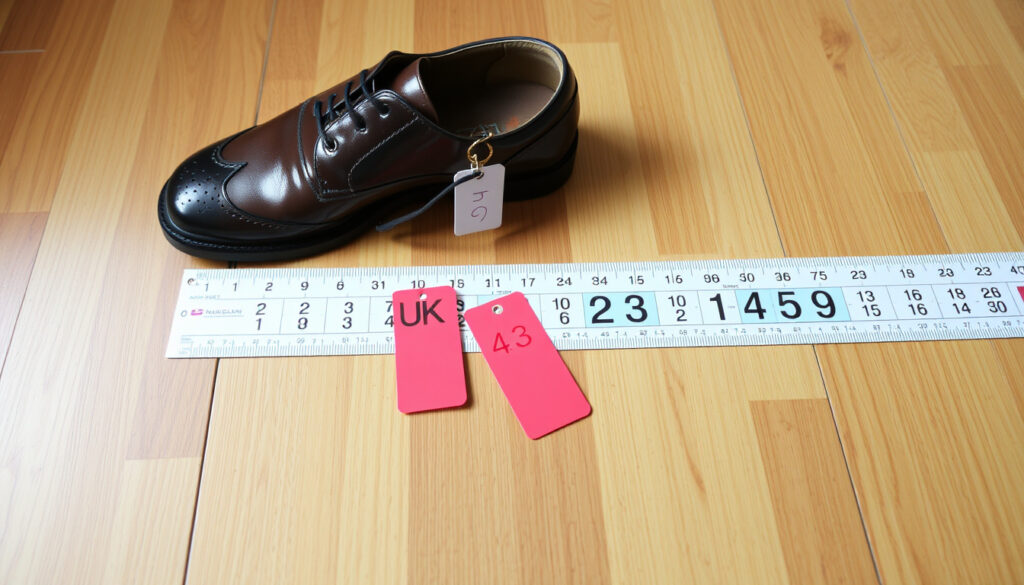
UK Size 9 in EU: Complete Shoe Size Conversion Guide
Shoe size conversions can feel like a guessing game, especially when a single UK number—size 9—means something different for men, women, and kids. If you’ve ever stared at an EU size label and wondered whether to grab a 40 or a 43, you’re not alone.
UK size 9 (men) EU conversion: 43 ·
UK size 9 (women) EU conversion: 40–41 ·
Men’s foot length for UK 9: 27.5 cm ·
Women’s foot length for UK 9: 26.0 cm ·
Brand variation range: ±0.5 EU size
Quick snapshot
- UK size 9 men’s equals EU 43 per Laughing Hens conversion chart.
- UK size 9 women’s converts to EU 40–41 across most retailers (Famous Footwear size charts).
- Men’s foot length for UK 9 is approximately 27.5 cm (standard Brannock measurement). (Laughing Hens conversion chart)
- Women’s foot length for UK 9 is approximately 26.0 cm (based on common conversion tables). (Laughing Hens conversion chart)
- Exact EU conversion can vary by brand and gender (Zappos shoe size conversion notes).
- Whether a size 40 corresponds to US 9 depends on the brand’s gender and sizing system. (Zappos shoe size conversion notes)
- EU shoe sizing has remained consistent since the adoption of the Paris point system in the 20th century (Wikipedia overview of shoe sizing history).
- Always verify against the brand’s own size chart before purchasing, especially for international orders (ASOS size chart recommendation).
A quick look at the key numbers reveals two clear patterns: men and women sit at different EU equivalents, and brand-specific charts can shift the result by half a size.
| Label | Value |
|---|---|
| UK 9 Men’s EU conversion | 43 |
| UK 9 Women’s EU conversion | 40–41 |
| Men’s foot length for UK 9 | 27.5 cm |
| Women’s foot length for UK 9 | 26.0 cm |
| Brands using half sizes | Nike, Adidas, New Balance |
The pattern: UK size 9 is not a single EU number—it splits by gender, then shifts by brand. The implication: a men’s 43 and a women’s 40–41 are both “size 9,” but they fit completely differently.
What is a size 9 in the EU?
The direct answer: UK size 9 in the EU system is 43 for men and 40–41 for women. Laughing Hens, a well-known online retailer, states that a men’s UK 9 corresponds to EU 43 (Laughing Hens conversion chart). For women, the range is wider: Famous Footwear lists a women’s US 9 as UK 7 and EU 40 (Famous Footwear women’s chart), while ASOS converts a women’s UK 9 directly to EU 42 with a foot length of 270 mm (ASOS women’s sizing). The trade-off: women shopping for UK 9 in Europe should expect anywhere from 40 to 42 depending on the brand’s last and width.
Is UK 9 size 42?
Sometimes. UK size 9 equates to EU 42 only in specific brand contexts. For example, ASOS women’s size chart lists UK 9 as EU 42 (ASOS women’s size chart). However, most men’s conversions set UK 9 at EU 43 (Laughing Hens men’s chart). So a men’s UK 9 is never exactly 42, but a women’s UK 9 can be.
Is size 9 a 42 or 43?
The answer depends on gender. For men, UK 9 is almost always 43. For women, it’s more often 40 or 41, with some brands bumping it to 42. Footlocker’s size guide confirms a men’s UK 9 as EU 43 (Footlocker size guide). The Soccer Factory’s conversion chart shows a US men’s 9 (which is roughly UK 8.5) at EU 42 (The Soccer Factory conversion), reinforcing that UK 9 men’s sits at EU 43.
Is size 9 a 40 or 41?
Women’s UK 9 is most commonly converted to EU 40 or 41. Grivet Outdoors notes that women’s UK sizes run 2 to 2.5 sizes smaller than US women’s (Grivet Outdoors size chart). Since a US women’s 9 is about a UK 6.5, a UK 9 is a full two sizes larger. EU 40 and 41 are the typical targets; brand-specific charts will settle the exact number.
Why is a size 40 not always a US 9?
The disconnect arises because the EU and US systems measure different things. EU sizes are based on foot length in centimeters, using the Paris point system where each size equals two-thirds of a centimeter (Wikipedia explanation of EU sizing). US sizing, by contrast, uses a different increment (barleycorns) and shifts by gender. A size 40 in EU corresponds to a foot length of about 25.3 cm, which can be a US women’s 9 (common) or a US men’s 6.5 or 7, depending on the conversion table. Zappos offers a shortcut: add 31 to US shoe size to get a rough EU number (Zappos conversion recommendation)—but that works better for men’s than for women’s.
How do EU and US sizing differ?
EU sizing is metric and unisex in sequence—a size 40 is a size 40 regardless of gender, though width may vary. US sizing has separate scales for men, women, and children. According to Grivet Outdoors, UK sizes run smaller than US sizes: men subtract about 0.5–1 size, women subtract about 2–2.5 sizes (Grivet Outdoors conversion notes). That’s why a US men’s 9 is roughly UK 8.5, while a US women’s 9 is UK 6.5.
Why does a size 40 sometimes correspond to US 9, sometimes to 7?
When a size 40 is labeled as US 9, it’s almost always a women’s shoe. When it’s labeled as US 7, it’s a men’s shoe. The same EU foot length gets split across two US gender scales. Famous Footwear lists a women’s US 9 as EU 40 (Famous Footwear women’s chart), while Laughing Hens lists a men’s UK 8 (which is close to US 8.5) as EU 42. The difference: gender-based US scaling multiplies the apparent mismatch.
Do boys’ feet grow faster at certain ages?
Yes. Boys’ feet undergo rapid growth during puberty, typically between ages 12 and 16 (Wikipedia overview of foot growth). During peak growth spurts, a boy’s foot can increase by as much as one full UK size every three to four months. This is relevant to shoe size conversion because parents often need to update size charts—what was a UK 9 last season may now be a UK 10 or larger. The average boy stops growing in height around 16–18, though foot growth may slow earlier (NHS growth spurt guidelines).
What are 5 signs that boys have stopped growing in height?
Five common indicators include: 1) Slower height increase over six months; 2) Foot size plateaus—the shoe size stays the same for a year; 3) Secondary sexual characteristics complete (e.g., voice deepens); 4) Bone age X-rays show fused growth plates; 5) Appetite stabilizes after peak pubertal hunger. These signs help parents know when shoe sizes are likely to stabilize, making a conversion guide like this one more definitive for older teens.
The implication: for teenagers whose feet are still growing, regularly remeasuring is more important than memorizing a conversion number. A UK 9 that fits in January may be too tight by June.
What foot type is the rarest?
The rarest foot shape is the Greek foot, where the second toe is longer than the big toe (Wikipedia foot shape classifications). It occurs in roughly 5–10% of populations of European descent. The Egyptian foot (the big toe being longest) is the most common, found in about 60–70% of people. Foot shape affects shoe fit: people with a Greek foot may need a half size larger to avoid pinching the second toe, even if their measured foot length matches a UK 9. This nuance explains why a single conversion number might feel wrong for some wearers, even when the chart says it’s correct.
What are the different foot shapes?
Besides Egyptian and Greek, the other common shape is the Roman foot (first three toes roughly equal in length), found in about 20–30% of people. A less common variant is the Peasant foot (all toes nearly the same length). Shape influences width and arch type, which in turn affects which EU size feels comfortable for a given UK 9.
How does foot shape affect shoe fit?
Foot shape determines where a shoe’s toe box presses most. A narrow Greek foot may fit a EU 40 even though the length measurement suggests EU 41. Conversely, a wide Egyptian foot may need EU 42 in a brand with a narrow last. Brands like New Balance and ASOS offer width variations; checking the shape-specific fit can save returns.
The pattern: a conversion chart can get you in the right ballpark, but your foot’s unique shape decides whether that number actually works.
Comparison table: UK size 9 in EU by brand and gender
Five different sources reveal a clear pattern: men’s UK 9 sits at EU 43, while women’s UK 9 varies from 40 to 42.
| Source | Gender | UK 9 EU Conversion | Foot length |
|---|---|---|---|
| Laughing Hens | Men’s | 43 | — |
| ASOS (women’s chart) | Women’s | 42 | 270 mm |
| Famous Footwear | Women’s | 40 (US 9 = UK 7) | — |
| The Soccer Factory | Men’s (US) | 42 (US 9 approx) | 26.0 cm (US 9) |
| Zappos | General | EU = US + 31 (approx) | — |
The trade-off: the women’s range spans three EU sizes (40–42). A shopper relying on a single conversion number might end up with a shoe that’s either too loose or too tight. The safest bet is to measure foot length in centimeters and compare it to the brand’s EU length chart.
UK size 9 is not a fixed EU number. Men get 43; women land between 40 and 42. Brand variation is real and can shift the fit by half a size. The only way to guarantee a correct conversion is to measure your foot in centimeters and match it to the brand’s published length chart—not a generic table.
Confirmed facts and what remains unclear
Confirmed facts
- UK size 9 men’s equals EU 43 per Laughing Hens conversion chart.
- Foot length for UK 9 men’s is approximately 27.5 cm (standard measurement).
- Women’s UK 9 converts to EU 40–41 across most retailers (Famous Footwear).
- ASOS women’s UK 9 foot length is 270 mm (ASOS women’s size chart).
What’s unclear
- Whether a UK 9 women’s should be EU 40, 41, or 42 depends on the brand’s last and sizing approach.
- Why some brands label size 40 as US 9 for women but US 7 for men is not standardized.
- How foot width and shape alter the comfortable EU size even when conversion appears correct.
The lack of a universal conversion standard means that online shoppers buying from European retailers should always cross-check the brand’s own size chart. A difference of one EU size (0.66 cm) can turn a comfortable fit into a shoe that slips or pinches.
Expert perspectives on UK size 9 conversion
“In our women’s sizing, a UK 9 corresponds to EU 42 with a foot length of 270 mm.”
— ASOS Size Chart (source)
“Men’s UK 9 equals EU 43 and US 10. Women’s UK 9 equals EU 43 and US 10.5.”
— Laughing Hens Conversion Chart (source)
“UK sizes run smaller than US sizes generally. For men, subtract about 0.5 to 1 size; for women, subtract about 2 to 2.5 sizes.”
— Grivet Outdoors Size Guide (source)
“A common shortcut is to add 31 to the US shoe size to get the approximate EU number.”
— Zappos Shoe Size Conversion (source)
What these quotes tell us: even within the same UK size, expert sources disagree on the exact EU number—especially for women. The inconsistency is not a mistake; it reflects real differences in how brands build their lasts and measure foot volume.
A UK size 9 in EU typically converts to EU 43 for men and EU 40–41 for women, as detailed in the UK size 9 to EU conversion guide.
Frequently asked questions
How do I measure my foot for shoe size?
Place your heel against a wall, stand on a piece of paper, mark the longest toe, and measure the distance in cm. Compare that length to the brand’s EU size chart, which uses Paris points (each size = two-thirds cm).
What is the difference between UK and US shoe sizing?
UK and US sizes use the same barleycorn system but differ in starting point. UK sizes are typically one full size smaller than US men’s sizes, and about 2–2.5 sizes smaller than US women’s sizes.
Are EU shoe sizes unisex?
Yes, EU sizes use the same number sequence for men, women, and children, based on foot length in cm. However, width and last shape may differ by gender even at the same number.
Why do some brands fit differently?
Brands use different lasts (foot molds) and allow varying tolerances for width and arch height. A EU 43 from Nike may feel narrower than a EU 43 from New Balance.
What is the average foot size for men?
In the UK, the average men’s shoe size is around 9 (EU 43). In the US, the average men’s size is 10.5 (EU 44).
How often should I remeasure my shoe size?
At least once a year for adults, and every 3–6 months for children and teenagers whose feet are still growing. Foot size can change with age due to ligament stretching.
Is UK 9 the same as US 9?
No. UK 9 is larger than US 9 for both men and women. For men, UK 9 equals US 10; for women, UK 9 equals US 11 or 11.5, depending on the brand.
For anyone shopping across the UK-EU border, the choice is clear: use foot length in centimeters as your primary reference, not a memorized number. A men’s UK 9 is consistently a EU 43, but women’s UK 9 can land at 40, 41, or 42. Measure your foot, check the brand’s cm chart, and ignore the one-size-fits-all conversion tables. Your feet—and your returns policy—will thank you.
More related posts
 72 Inches in CM: Conversion, Height, and Practical Uses
 A House of Dynamite Ending: What Happens & Why Abrupt
 5 Day Weather Forecast Ireland: Reliable & Official Sources
 Laser Hair Removal Galway: Cost, Safety & Prep Guide
 What Time Does Smyths Close? Store Hours & Opening Times
 Sonic X Shadow Generations Review: Full Game & New Content
 How to Get Blood Out of Clothe : 5 Method That Actually Work
 Loans Ireland Bad Credit: Can You Get One? 2025 Guide
