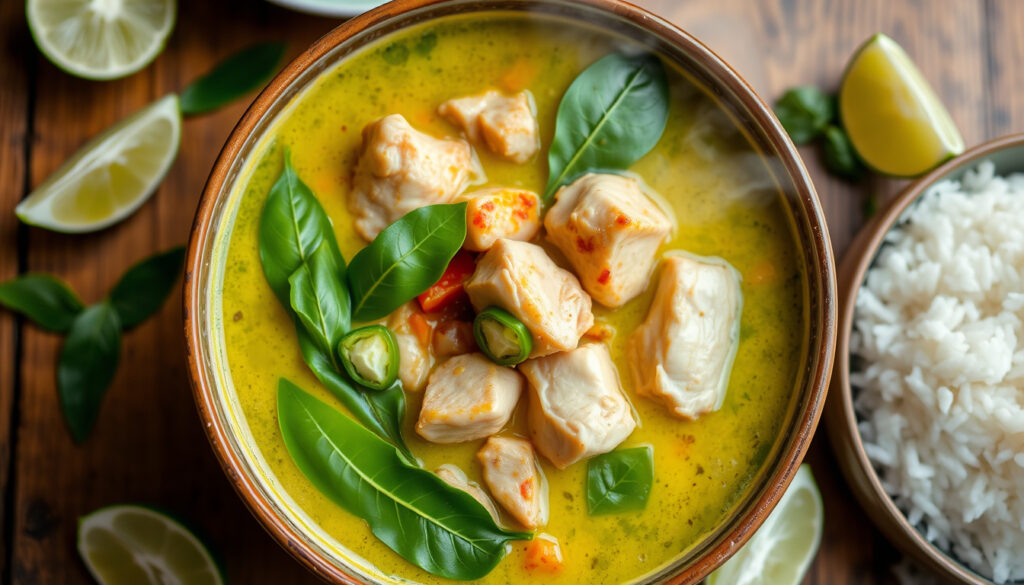
Thai Green Curry Recipe – Authentic & Easy (30 Min)
Anyone who’s ever ordered a Thai green curry at a restaurant knows that moment when the first spoonful hits — creamy, spicy, fragrant, and somehow impossibly balanced. The Thailand Foundation, the Thai cultural institution, notes that green curry (kaeng khiao wan) emerged as a distinct dish in the early 20th century, and this recipe breaks down exactly how to achieve that balance at home, from the paste to the plate, in about 30 minutes — whether you’re using store-bought paste or making your own.
Prep time: 10 minutes · Cook time: 20 minutes · Total time: 30 minutes · Servings: 4 · Calories per serving: ~450 kcal
Quick snapshot
- Uses store-bought paste, freshened up with extra ginger and lime per BBC Good Food (trusted recipe publisher)
- 30 minutes total (Thailand Foundation (Thai cultural institution))
- Minimal chopping (BBC Good Food (trusted recipe publisher))
- Homemade paste from scratch using traditional ingredients (PBS SoCal (public media cooking series))
- Rich, complex flavor from fresh green chilies, galangal, and lemongrass (PBS SoCal (public media cooking series))
- Disjointed chicken thighs for traditional richness (Eating Thai Food (Thai cuisine specialist))
- Tofu or tempeh protein with vegetable broth (Woon Heng (vegan recipe blog))
- Vegan fish sauce alternative (e.g., soy sauce + seaweed) (Woon Heng (vegan recipe blog))
- Bamboo shoots and Thai eggplant as traditional veg (Woon Heng (vegan recipe blog))
- Adjust by number of green chilies – mild: remove seeds (National Geographic (travel & culture magazine))
- Hot: add bird’s eye chilies (National Geographic (travel & culture magazine))
- Palm sugar and coconut milk balance the heat (National Geographic (travel & culture magazine))
Five key facts about Thai green curry at a glance:
| Attribute | Detail |
|---|---|
| Origin | Thailand – Thailand Foundation (Thai cultural institution) |
| Main spice | Green chilies – National Geographic (travel & culture magazine) |
| Key flavor | Coconut milk and fish sauce (Thailand Foundation (Thai cultural institution)) |
| Difficulty | Medium – requires multi-step paste or careful simmering |
| Time | 30 minutes (RecipeTin Eats (recipe developer)) |
What are the ingredients for a Thai green curry?
The Curry Paste
The soul of any Thai green curry lies in its paste. A traditional green curry paste typically contains fresh green chilies, lemongrass, galangal, shallots, garlic, and shrimp paste (PBS SoCal (public media cooking series)). Joshua Weissman (recipe creator) adds toasted coriander, cumin, and peppercorns for extra depth (Joshua Weissman (recipe creator)). The paste is pounded in a mortar and pestle or blended until smooth.
Homemade paste takes 15 minutes of pounding but delivers a fresher, more aromatic result than store-bought. If you use a blender, add a splash of oil to keep the paste moving – Woon Heng (vegan recipe blog) recommends this shortcut.
Coconut Milk
Full-fat coconut milk provides the richness and body that define a quality green curry (Thailand Foundation (Thai cultural institution)). The thick cream skimmed from the top is used to fry the paste; the thinner milk is added later to control consistency (PBS SoCal (public media cooking series)).
Protein and Vegetables
Common proteins include chicken (thighs for maximum flavour), beef, or tofu. Dassana’s Veg Recipes (Indian food blog) suggests tofu for a vegetarian version (Dassana’s Veg Recipes (Indian food blog)). Vegetables such as bamboo shoots, bell peppers, Thai eggplant, and pea eggplant are traditional (Thailand Foundation (Thai cultural institution)). Coley Cooks (recipe blogger) advises adding the longest-cooking ingredients first (Coley Cooks (recipe blogger)).
Seasonings
Fish sauce, palm sugar, and kaffir lime leaves are essential. Thailand Foundation (Thai cultural institution) includes them in its sample formula (Thailand Foundation (Thai cultural institution)). Fresh Thai basil is added just before serving for its anise-like aroma.
What is the secret ingredient to good green curry?
Fish Sauce for Umami
Pailin of Hot Thai Kitchen (Thai cooking educator) says, “It adds a savory depth that makes the curry sing” (Eating Thai Food (Thai cuisine specialist)). Fish sauce provides the saltiness and umami that many cooks consider the secret backbone.
Palm Sugar for Balance
Palm sugar (not white sugar) balances the heat of the chilies and the acidity of the lime without making the curry sweet (Thailand Foundation (Thai cultural institution)).
Thai Basil for Aroma
Fresh Thai basil, added off the heat, releases a distinct anise-like fragrance that distinguishes authentic green curry from generic versions (National Geographic (travel & culture magazine)).
What gives Thai green curry its flavour?
Green Curry Paste Base
The fresh green chilies and herbs in the paste create the characteristic colour and heat. National Geographic (travel & culture magazine) notes that chilies arrived in Thailand in the late 1600s via Portuguese traders, which helped shape the country’s curry culture (National Geographic (travel & culture magazine)).
Coconut Cream and Herbs
Coconut cream adds richness and mellows the spice. The fat carries the fat-soluble flavors of the paste. Kaffir lime leaves and lemongrass add citrusy notes (Thailand Foundation (Thai cultural institution)).
Lime and Fish Sauce
Lime juice provides bright acidity; fish sauce delivers savory depth. Together they cut through the richness and tie the dish together (Eating Thai Food (Thai cuisine specialist)).
How to make a simple Thai green curry?
Freshening Up Store-Bought Paste
BBC Good Food (trusted recipe publisher) recommends adding extra ginger, garlic, and lime zest to store-bought paste for a quick upgrade (BBC Good Food (trusted recipe publisher)). Gently fry the paste in a little coconut cream until aromatic – about 2 minutes (RecipeTin Eats (recipe developer)).
Quick Cooking Method
- Heat 200 ml coconut cream in a wok. Add 2–3 tbsp green curry paste and fry until fragrant (Thailand Foundation (Thai cultural institution)).
- Add chicken (or tofu) and brown lightly. Add remaining coconut milk, plus ½ cup chicken or vegetable stock.
- Simmer 10 minutes, then add bamboo shoots and Thai eggplant. Cook 5 more minutes.
- Season with fish sauce, palm sugar, and lime juice. Remove from heat and stir in Thai basil.
RecipeTin Eats (recipe developer) warns not to over-simmer: the sauce should remain slightly thin and will darken with prolonged cooking (RecipeTin Eats (recipe developer)).
For time-pressed cooks in Ireland, a 30-minute curry using upgraded store-bought paste is dramatically better than takeaway. The key is treating the paste with respect – fry it properly and don’t drown it in liquid.
The implication for home cooks: this simple method delivers a curry that rivals restaurant quality in under half an hour.
How to make real Thai green curry?
Making Your Own Curry Paste from Scratch
For the most authentic result, pound your own paste. PBS SoCal (public media cooking series) lists lemongrass, galangal, shallot, garlic, shrimp paste, green chile pepper, and turmeric as base ingredients (PBS SoCal (public media cooking series)). Joshua Weissman (recipe creator) toasts coriander, cumin, and peppercorns before grinding them into the paste (Joshua Weissman (recipe creator)). Use a mortar and pestle for better texture, or a blender if you’re short on time.
Authentic Techniques and Tips
- Use disjointed chicken thighs for traditional richness (Eating Thai Food (Thai cuisine specialist)).
- Fry the paste in oil for 3–4 minutes until it begins to stick to the pan (Joshua Weissman (recipe creator)).
- Add kaffir lime leaves and Thai basil at the end for freshness (Thailand Foundation (Thai cultural institution)).
- Serve with jasmine rice, not noodles – the rice soaks up the sauce.
What’s confirmed and what’s unclear about Thai green curry?
Confirmed facts
- Fish sauce is a key ingredient (Thailand Foundation (Thai cultural institution))
- Green curry paste uses fresh green chilies (National Geographic (travel & culture magazine))
- Coconut milk must be full-fat for best results (PBS SoCal (public media cooking series))
What’s unclear
- Exact secret ingredient varies by family recipe
- Some recipes add kaffir lime leaves, others omit them
- The exact historical timeline of green curry’s evolution is debated among food historians (Thailand Foundation (Thai cultural institution) notes early 20th-century origins, but precise date is uncertain)
What the experts say
“Fish sauce adds a savory depth that makes the curry sing.”
— Pailin (Hot Thai Kitchen), Eating Thai Food (Thai cuisine educator)
“Freshen it up with extra ginger and lime for a quick upgrade.”
— BBC Good Food, BBC Good Food (trusted recipe publisher)
The implication for home cooks: fish sauce is non-negotiable, but you don’t need a pantry full of exotic ingredients to start. Upgrade what you have, respect the technique, and the curry will reward you.
For an authentic step-by-step guide to making this dish, check out the Thai Green Curry Recipe from Canada Viewpoint.
Frequently asked questions
Can I make Thai green curry vegetarian?
Yes. Use tofu or tempeh, vegetable broth, and a vegan fish sauce substitute (soy sauce with a pinch of seaweed works). Woon Heng (vegan recipe blog) offers a full vegan version.
What vegetables are best in Thai green curry?
Thai eggplant, bamboo shoots, bell peppers, and broccolini. Thailand Foundation (Thai cultural institution) includes pea eggplant and Thai basil (Thailand Foundation (Thai cultural institution)).
How long does Thai green curry keep in the fridge?
Store in an airtight container for up to 3 days. Reheat gently to avoid splitting the coconut milk.
Can I freeze Thai green curry?
Yes, the curry freezes well for up to 3 months. Thaw in the fridge and reheat over low heat.
What is the best coconut milk brand for curry?
Full-fat canned brands like Chaokoh or Aroy-D are widely preferred by Thai cooks (Eating Thai Food (Thai cuisine specialist)). Avoid light coconut milk – it lacks the fat needed for proper texture.
Is Thai green curry spicy?
It can be. The heat comes from green chilies in the paste. For a milder curry, remove seeds from the chilies; for extra heat, add bird’s eye chilies (National Geographic (travel & culture magazine)).
How to adjust spiciness in Thai green curry?
Increase or reduce the number of green chilies in the paste. Add more coconut milk to tame the heat. Palm sugar also helps balance the spice.
Can I use red curry paste instead of green?
Technically yes, but it will produce a red curry, not green. The flavor profiles differ – red paste uses dried red chilies, while green paste relies on fresh green ones. For an authentic green curry, stick with green paste.
Related reading
- Sex on the Beach Cocktail: Recipe, Ingredients & History
- How to Reduce Sugar in Your Diet: Signs, Benefits & Tips
For home cooks in Ireland, the choice is clear: take 30 minutes to make this green curry, or settle for takeaway that will never be quite as fresh. Start with a good paste, respect the technique, and you’ll have a bowl that rivals any restaurant.
More related posts
 Best Coding YouTube Channels: Expert Picks & Reddit Finds
 Shona McGarty Movies and TV Shows: Complete Filmography
 The Rip Movie True Story: The Real Heist and Unsolved Case
 Cowboys vs Chargers Player Stats: Final Score & Key Performances
 Vodafone Online Top Up: Quick Steps for Pay As You Go
 That’s TV 2 Schedule: Channel, Catch Up & Freesat Removal (2025)
 La Liga Matches 2026-2027: Schedule and Viewing Guide
 Sugar Rush 1000 Demo: Play Free with x1024 Multipliers
