Two Way Traffic Sign: Meaning, Appearance, and Driver Response
There’s a moment on every driving test when the instructor points ahead and asks, “What does that sign mean?” For the two-way traffic sign, many learners freeze — is it a warning, a direction, or something else entirely? This guide breaks down how to read the sign, why it comes in two different orientations, and exactly what drivers should do when they spot it on the road ahead.
Shape: Diamond ·
Background color: Yellow ·
Symbol: Two black arrows pointing in opposite directions ·
Placement: Before a road transitions from one-way to two-way traffic ·
Common in: Urban streets, rural roads, and construction zones
Quick snapshot
- Two-way traffic signs are diamond-shaped with a yellow background and black arrows (Driving School (driver education authority))
- Horizontal arrows indicate side-by-side lanes; vertical arrows indicate stacked directions (Canada Driving Exam (driver testing resource))
- Drivers must be prepared for oncoming traffic and stay in their lane (Driving-Tests.org (practice test publisher))
- Exact historical origin of the sign design remains undocumented in public sources (Roadsky Safety (road safety supplier))
- Uniformity of sign dimensions across all countries is not standardized globally (TrafficThing (road signage retailer))
- Sign is posted at the end of a one-way street or where a divided road becomes undivided (Surepass Driving School (driver education provider))
- Also placed where a dual carriageway (divided highway) ends and transitions to a single carriageway (Road Traffic Signs (road sign manufacturer))
- Drivers should reduce speed and prepare to encounter oncoming traffic (Driving-Tests.org (practice test publisher))
- Position the vehicle to the appropriate side (e.g., keep left in the UK) (Passrates UK (UK theory test resource))
| Attribute | Detail |
|---|---|
| Official name | Two-way traffic sign |
| Shape | Diamond |
| Color | Yellow background, black arrows |
| Meaning | Road ahead carries traffic in both directions |
| Placement | Before the start of a two-way road |
| Variants | Horizontal arrow sign, vertical arrow sign |
What does the two way traffic sign mean?
The two-way traffic sign is a warning — not a command — that the road ahead will carry vehicles moving in opposite directions. According to Driving School (driver education authority), the sign alerts drivers to the presence of oncoming traffic so they can adjust their lane position, speed, and passing decisions before entering the bidirectional stretch.
It is generally classified as a warning sign rather than a regulatory sign across most driver-education materials, meaning it advises caution without imposing a penalty if ignored — though ignoring it can obviously lead to collisions.
The sign does not indicate road width or the number of lanes; it only signals that traffic will meet you from the opposite direction. As Surepass Driving School (driver education provider) points out, drivers sometimes mistake it for a direction change — it is not. The road itself stays the same; only the traffic pattern changes.
What does the sign look like?
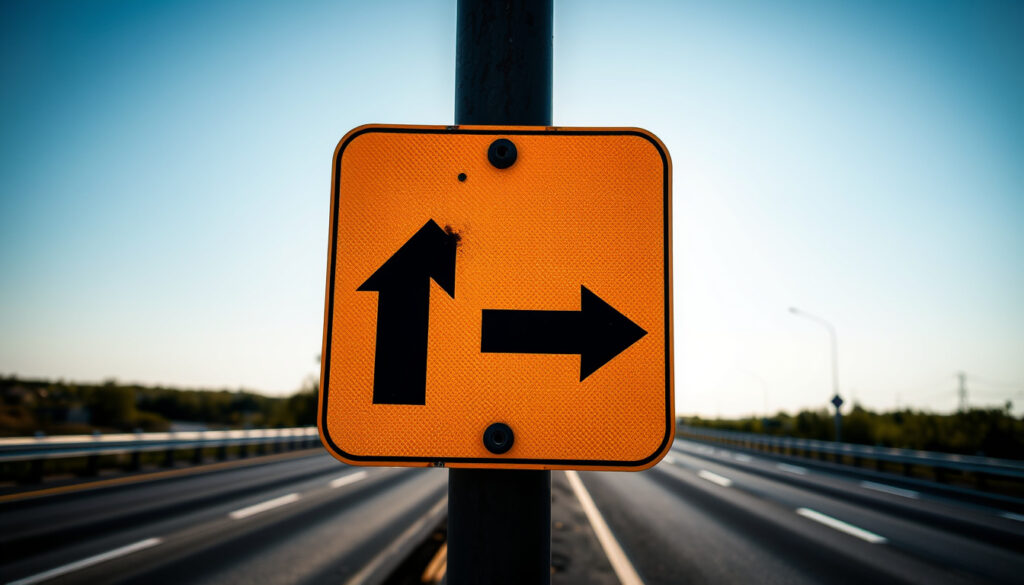
In North America, the sign is a yellow diamond with two black arrows pointing in opposite directions. The arrows can be arranged side by side (horizontal) or one above the other (vertical). A common variant shows one arrow pointing left and the other pointing right, signaling that two lanes of traffic travel adjacent to each other in opposite directions (YouTube (driving instruction explainer)).
In the UK and Ireland, the design flips to a red-bordered triangle (the standard warning shape) with two vertical arrows — one pointing up and one pointing down — again indicating opposing traffic flows. According to Passrates UK (UK theory test resource), the vertical orientation is standard in the UK because space constraints on triangular signs favour stacked arrows.
Six key attributes, one pattern: the shape and colour carry meaning across jurisdictions, but the arrow orientation often depends on local sign-design conventions.
| Region | Shape | Background | Arrow layout | Primary source |
|---|---|---|---|---|
| USA / Canada | Diamond | Yellow | Horizontal (arrows side by side) | Driving School |
| UK / Ireland | Triangle | White with red border | Vertical (arrows stacked) | Passrates UK |
| Continental Europe | Triangle | White with red border | Vertical (arrows stacked) | Vienna Convention on Road Signs |
The implication: drivers crossing borders — or studying for tests in a different country — need to learn the local sign shape, not just the concept. A yellow diamond means regulatory or warning in the US but may not appear at all in the UK.
Where is it placed?
Signs are positioned before the physical transition point — typically 100 to 200 feet in advance on urban roads, and farther on high-speed rural roads. According to Surepass Driving School (driver education provider), the sign is commonly posted where a one-way street meets a two-way road, where a divided highway (dual carriageway) narrows into a single two-way carriageway, or at the end of a one-way section in construction zones.
Road Traffic Signs (road sign manufacturer) adds that the sign also appears near the exits of parking facilities, bridges, and tunnels where traffic patterns shift from one-way to two-way.
What is the difference between horizontal and vertical two-way traffic signs?
The most common question learners ask — “Why are the arrows sometimes horizontal and sometimes vertical?” — comes down to the sign’s physical shape and its intended reading perspective. Horizontal arrow signs (side-by-side arrows) tell drivers that two adjacent lanes carry traffic in opposite directions. Vertical arrow signs (stacked arrows) are used when the sign is narrower, when it hangs overhead, or when it indicates that the road itself bends or changes direction while still carrying bidirectional traffic (YouTube (road sign explainer video)).
According to Canada Driving Exam (driver testing resource), a driver who encounters a vertical sign in a jurisdiction where horizontal signs are standard may be confused about whether the road itself changes direction. The sign does not mean the road turns — it means traffic flows both ways.
When is a horizontal sign used?
- Most common in the United States and Canada (Driving School)
- Preferred on wide sign boards where arrows can sit side by side
- Often paired with permanent signage on multi-lane two-way roads
- Indicates that opposing traffic runs in parallel lanes alongside each other
When is a vertical sign used?
- Standard in the UK, Ireland, and most European countries (Passrates UK)
- Used on narrow sign posts, gantries, or triangular warning signs
- Appears where a road transitions from one-way to two-way after a bend
- Sometimes used to indicate the road ahead goes over a bridge or through a tunnel with opposing traffic
Are there regional preferences?
Yes — and the difference matters for anyone crossing borders while driving. A driver from Ireland or the UK who visits Canada will see a yellow diamond with side arrows and might not immediately recognize it as the same warning. Conversely, an American driver in Ireland might mistake the red triangle with stacked arrows for a warning about a road narrowing, not a shift to bidirectional traffic. Roadsky Safety (road safety supplier) notes that the Vienna Convention on Road Signs, adopted by 52 countries, defines the triangular warning sign with vertical arrows — while North America follows the Manual on Uniform Traffic Control Devices (MUTCD), which specifies the yellow diamond.
What should I do when I see a two-way sign?
When you spot the two-way traffic sign, your immediate task is to shift from a one-way mindset — where all traffic comes from behind or ahead in the same direction — to a two-way mindset where vehicles approach from the opposite lane. According to Driving-Tests.org (practice test publisher), the sign is specifically designed to reduce accident risk by giving drivers time to slow down, adjust lane position, and avoid overtaking.
How should I adjust my driving?
- Stay in your lane. The most critical action. Opposing traffic will use the lane next to yours.
- Reduce speed if visibility is limited or if the road appears narrow (Road Traffic Signs)
- Check your mirrors and blind spots — other drivers may be reacting differently behind you
- Do not overtake unless there is a clear passing lane and you have verified the road ahead is clear of oncoming traffic (Driving-Tests.org)
- Position to the appropriate side: keep left if driving in the UK/Ireland (Passrates UK), keep right in the US/Canada
What if I am on a one-way road approaching a two-way section?
This is the scenario where the sign does its most important work. According to Red Driving School (UK driver training provider), a driver leaving a one-way street must adjust their driving position — they may have been driving in the centre of the road or hugging the curb depending on local one-way practice. The two-way sign tells them to shift to the correct lane and prepare for head-on approaching vehicles.
What this means: the most dangerous moment is the transition zone. Accident data from Jackwin Safety (road safety consultancy) suggests that confusion over road direction change contributes to a measurable share of intersection and transition-point collisions. The sign exists precisely to close that gap.
How to identify a two-way road
Beyond signs, the road itself gives visual clues that tell you whether traffic flows both ways. Knowing how to read the road surface, markings, and width helps confirm what the sign warned you about.
What road markings indicate two-way traffic?
- A centre line — either dashed (allowing passing when safe) or solid (no passing) — divides the road into two opposing lanes (Surepass Driving School)
- In urban areas, centre lines may be painted with reflectors (raised pavement markers) that are visible at night
- Some two-way roads have a centre median (physical barrier or painted island) separating directions
- Roads with no centre line — typically narrow rural lanes — may still be two-way; the lack of markings does not mean one-way
What about signs?
Besides the two-way traffic warning sign, additional signage may appear:
- A “two-way traffic ends” sign (sometimes showing a crossed-out version of the two-way arrows) marks the transition back to one-way (Road Traffic Signs)
- In some jurisdictions, a two-way sign appears alongside a “keep left” or “keep right” regulatory sign to reinforce lane discipline
- At roundabout exits, a two-way sign may warn drivers entering a road that carries bidirectional traffic immediately after the junction
The pattern: the sign pre-warns; the road markings confirm. Both systems work together — sign alone should trigger caution, and markings should guide your precise lane position.
What is a two-way traffic road?
A two-way traffic road is any road where vehicles travel in opposite directions on the same carriageway. According to Driving School (driver education authority), the road may have one lane in each direction or multiple lanes per direction — what defines it as two-way is the presence of opposing traffic flows, not the number of lanes.
In practice, most roads outside of motorways and urban one-way systems are two-way roads. The distinction matters most when a road changes from one-way to two-way, which is where the two-way traffic sign does its job.
How does it differ from a one-way road?
- On a one-way road, all traffic moves in a single direction. There is no opposing lane.
- On a two-way road, traffic moves in two directions. Drivers must stay in their designated lane and cannot use the opposing lane for passing unless specifically permitted.
- One-way roads often have simpler intersections because turning traffic does not conflict with oncoming vehicles. Two-way roads require more complex junction designs, turn lanes, and signalling (Surepass Driving School).
Can a two-way road have multiple lanes?
Yes. Many multi-lane roads are two-way — they simply dedicate a certain number of lanes in each direction. For example, a six-lane road might have three lanes in each direction separated by a median. As Canada Driving Exam (driver testing resource) notes, a two-way sign can appear even on multi-lane roads if a divided median ends or if the road narrows from a divided highway to a single carriageway with two-way traffic.
Drivers on two-way roads should also be familiar with the no-passing zone sign, which prohibits overtaking where visibility is limited.
Frequently asked questions
Are two-way traffic signs mandatory on all two-way roads?
No. Most safety and transportation authorities recommend them, especially at transition points from one-way to two-way. However, not every two-way road has a sign — many residential streets and rural roads lack formal signage and rely on road markings and driver awareness. According to Road Traffic Signs (road sign manufacturer), sign placement follows engineering judgement based on speed, traffic volume, and accident history.
What is the penalty for ignoring a two-way traffic sign?
Because the sign is a warning rather than a regulatory command, there is no specific fine for ignoring it. However, if ignoring the sign leads to a traffic violation (e.g., driving on the wrong side of the road, improper overtaking, or causing a collision), standard penalties apply. In the UK, driving on the wrong side of the road can result in 3-6 penalty points and a fine up to £5,000 (Passrates UK).
Do two-way traffic signs exist on highways?
No — highways and motorways are typically divided roads (dual carriageways) with a physical median separating directions. Two-way signs appear where a highway ends and the road narrows to a single carriageway, or on exit ramps that lead to two-way surface streets. According to Surepass Driving School, the “dual carriageway ends” sign effectively functions as a two-way traffic warning.
Are there different colors for two-way signs in different countries?
Yes. In North America, the sign is yellow with black arrows. In the UK, Ireland, and most of Europe, it is a white triangle with a red border and black arrows. Some countries (e.g., Australia) use yellow diamonds similar to the US. Roadsky Safety (road safety supplier) notes that colour schemes follow either the MUTCD (Americas) or the Vienna Convention (Europe and elsewhere).
Can two-way traffic signs be used on roundabouts?
Not typically on the roundabout itself, but they appear on approach roads and at roundabout exits. A driver leaving a roundabout onto a two-way road may encounter a two-way traffic sign if the exit road immediately carries opposing traffic. According to Canada Driving Exam (driver testing resource), this is common where roundabouts connect to residential streets.
What is the difference between a two-way traffic sign and a two-way traffic end sign?
The two-way traffic sign warns that the road ahead carries bidirectional traffic. The two-way traffic end sign — typically the same symbol with a diagonal red line through it (similar to a “no entry” strike-through) — indicates that the two-way section is ending and the road will soon become a one-way road. According to Road Traffic Signs (road sign manufacturer), the end sign appears at the transition where a two-way road meets a one-way street system.
How often should two-way traffic signs be replaced?
Most transportation agencies recommend inspection every 1-2 years and replacement when reflectivity falls below mandated thresholds. Signs exposed to direct sunlight, weathering, or vandalism may need replacement sooner. According to TrafficThing (road signage retailer), modern high-intensity retroreflective sheeting can last 7-10 years under normal conditions.
Is there a standard size for two-way traffic signs?
Yes, but sizes vary by region. In the US, the MUTCD specifies minimum dimensions based on road speed: 60 cm x 60 cm for 40 mph roads, 75 cm x 75 cm for 50 mph roads, and 90 cm x 90 cm or larger for highways. In Europe, the standard triangular sign is 900 mm on the side for general use, with 600 mm versions for low-speed zones. According to Driving School (driver education authority), no global uniformity exists, which is why travellers should learn local sign shapes.
For a driver in Ireland or the UK who is used to the red triangle with stacked arrows, the yellow diamond with side arrows seen in North America can be disorienting — and the reverse is true for Canadian drivers visiting Ireland. The takeaway is clear: learn the local sign system before you drive abroad, because the two-way traffic sign is a universal concept that wears different clothes depending on where you are. Nissan Navara for Sale Ireland and Dublin to Limerick Bus Guide may be relevant further reading on driving in Ireland.
More related posts
 Utah Jazz vs Lakers Match Player Stats: 131-107 Result
 Soto Betawi Near Me: Find Authentic Jakarta Beef Soup
 Cowboys vs Chargers Player Stats: Final Score & Key Performances
 President Michael D. Higgins: Life, Career, and Legacy
 The Autopsy of Jane Doe: Is It Scary? Plot and Meaning
 Scent of a Woman: Cast, Oscar Win & Famous Line
 Can You Take Ibuprofen with Paracetamol? Safety, Dosage & Timing
 Is Katie Taylor Married? Husband Sean McCavanagh & Kids
