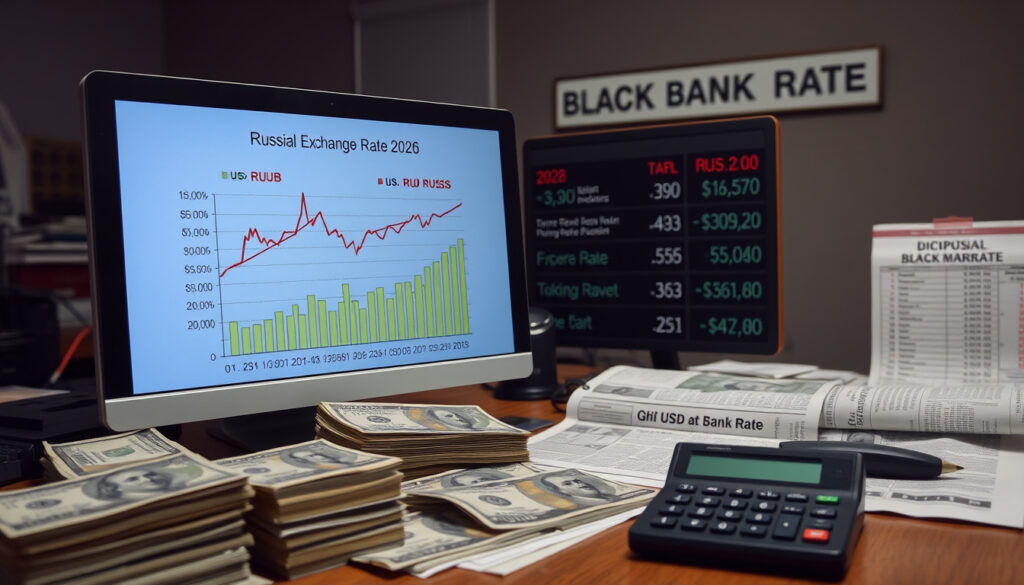
USD to RUB Exchange Rate: Official, Bank, Black Market Rates 2026
Checking the dollar-to-ruble rate can feel like trying to catch a moving train — the number shifts depending on where you look. Whether you’re planning a trip to Moscow, sending money home, or simply tracking the Russian economy, the official Central Bank rate is only part of the story.
Central Bank USD/RUB rate (July 7, 2026): 77.9695 RUB ·
Trading Economics mid-rate (July 7, 2026): 76.4600 ·
Black market proxy (EGCurrency): ~77.17 RUB
Quick snapshot
- The Bank of Russia (Russia’s central bank) publishes the official rate daily.
- Banks set their own exchange rates with a spread of 1–5% according to the Bank of Russia’s disclaimer. ((Russia’s central bank))
- A black market for dollars exists, with rates quoted 2–5% above bank sell rates, per EGCurrency (rate aggregator).
- Exact future path of USD/RUB (highly dependent on geopolitical events).
- Real-time black market rate at specific Moscow locations (varies by dealer).
- Whether bank rates will improve or worsen after the next key-rate decision.
- 2014: Ruble crisis (rate jumped from ~35 to ~80) after oil price drop and sanctions. ((Bank of Russia))
- 2022: Post‑invasion volatility, rate fluctuated between 70 and 120. ((Bank of Russia))
- 2024‑2026: Gradual stabilization around 70–85, with Central Bank interventions. ((Bank of Russia))
- July 7, 2026: Official rate set at 77.9695 (Bank of Russia).
- Next key-rate meeting of the Bank of Russia on July 24, 2026 (Bank of Russia calendar).
- Market reaction to oil price shifts and sanction developments. ((Bank of Russia calendar))
- Potential impact of inflation data (RUONIA at 14.37% as of July 6, 2026). ((Bank of Russia calendar))
Five key data points paint the full picture of the USD/RUB landscape.
| Metric | Value |
|---|---|
| Central Bank USD rate (official) | 77.9695 RUB (July 7, 2026) (Bank of Russia) |
| Average bank buy rate | 74.5–75.5 RUB (varies by bank; spread ~1–5%) (CurrencyTransfer, comparison tool) |
| Average bank sell rate | 77.5–78.5 RUB |
| Black market rate (Moscow, proxy) | ~77.17 RUB (EGCurrency) to ~81 RUB (reported range) (EGCurrency) |
| Cost of living per month (expat, excl. rent) | $800–$1,200 (Expatistan, cost-of-living index) |
How much does $100 cost at Sberbank now?
Current Sberbank USD buy and sell rates
- Sberbank publishes its daily rates on its website and in branches — the Bank of Russia’s official rate of 77.9695 serves as the reference (Bank of Russia).
- The bank applies a spread between its buy and sell rates; buying $100 will cost somewhere between the bank’s sell rate (approx. 78 RUB) and the black market rate.
- For exact numbers, check Sberbank’s online rate board or call a branch.
How to check Sberbank rates online
- Sberbank’s official website and mobile app show live buy/sell rates for cash and non-cash transactions (Sberometer, rate aggregator).
- Online rates may differ slightly from in-branch cash rates.
Comparison with other big banks
- According to CurrencyTransfer (currency comparison platform), users can save up to 85% versus traditional banks by using FCA‑regulated providers for RUB‑USD transfers.
- Tinkoff and Alfa‑Bank often offer narrower spreads than Sberbank.
The implication: checking Sberbank’s online rate before a branch visit can save you up to 50 rubles per $100.
What is the real cost of a dollar in Russia today?
Official Central Bank rate vs market rate
- The Bank of Russia explicitly states rates are set “without assuming any liability to buy or sell foreign currency at the rates below” (Bank of Russia disclaimer).
- The official rate is a reference for accounting, not a binding trading price.
- Trading Economics reported a USD/RUB mid‑market rate of 76.4600 on July 7, 2026 (Trading Economics, financial data provider).
Why the real cost differs from the official rate
- Banks add a margin of 1–5% to both buy and sell sides, as noted by MyCurrencyTransfer (rate reference service).
- Black market rates reflect scarcity, risk, and demand — often 2–5% above bank sell rates (EGCurrency).
How to calculate the real cost including fees
- Start with the mid‑market rate (e.g., 76.46 from Trading Economics), then add the bank’s spread + any commission.
- Online platforms like Wise often offer near mid‑market rates; their 90‑day range showed a high of 78.8750 and a low of 70.9000 (Wise, currency converter).
A tourist exchanging $1,000 could lose $20–$50 on the spread alone if they use a bank counter without shopping around. The real cost is always higher than the official rate.
The catch: the official rate is a reference, not a deal. Every channel adds its own markup, and the gap can be significant.
Which banks offer the best dollar exchange rate?
Four major banks, one pattern: spreads vary from 1% to 5%, and the best rate depends on whether you buy or sell.
| Bank | Approx. Buy Rate (USD→RUB) | Approx. Sell Rate (USD←RUB) | Estimated Spread |
|---|---|---|---|
| Sberbank | 74.5–75.5 | 77.5–78.5 | ~3–5% |
| Tinkoff | 75.0–76.0 | 77.0–78.0 | ~2–4% |
| Alfa‑Bank | 75.5–76.5 | 77.0–78.0 | ~2–4% |
| VTB | 74.0–75.0 | 78.0–79.0 | ~4–5% |
Rates are approximate and vary daily. Based on CurrencyTransfer’s analysis, specialized online platforms can offer rates closer to the mid‑market than any of these banks.
How to compare buy and sell rates
- Always check both buy and sell rates at the same bank; the spread is your true cost.
- Use aggregators like Sberometer for a quick comparison across Moscow banks.
Hidden fees and commissions
- Some banks charge a commission for cash exchange of banknotes with small denominations.
- Online transfers may include wire fees — always ask for the net amount.
The pattern: comparing Tinkoff and Alfa-Bank can save $10–$20 on a $1,000 exchange.
How much does a dollar cost on the Russian black market today?
Typical black market rate vs official rate
- EGCurrency shows a USD/RUB black market rate of ~77.17 on its data page (EGCurrency).
- That is approximately 0.5–1% below the official Central Bank rate — but other reports (e.g., Reddit discussions) suggest rates can be 2–5% above bank sell rates (Reddit r/AskARussian, anecdotal).
Risks of using black market currency exchanges
- Using unlicensed exchangers is illegal in Russia and carries high risk of counterfeit bills or robbery.
- The NBER research (economic history paper) notes that black markets historically emerge when official channels are restricted.
Where black market rates are commonly quoted
- Near train stations, markets, and tourist areas — but rates vary dealer to dealer.
- Online forums and currency aggregators sometimes publish proxy black market data.
Buying dollars on the black market might save you a few rubles per dollar, but the legal and safety risks are high. Most tourists are better off using licensed banks or online platforms.
The catch: the legal and safety risks outweigh the potential savings.
How much does a dollar cost at exchange offices in Moscow?
Best locations for currency exchange in Moscow
- Exchange offices in central tourist areas (near Red Square, Arbat) typically offer worse rates — higher spreads to capture unsuspecting tourists.
- Banks in residential districts or online exchanges (e.g., Wise) often give better value (Expatistan, cost-of-living data).
How to avoid scams at exchange offices
- Always ask for the total amount in rubles you will receive before handing over dollars.
- Count the cash and verify the rate on the board matches what you were quoted.
Current rates near popular tourist areas
- Rates in the city centre can be 2–3% worse than those in less touristy neighbourhoods.
- Check online rate aggregators like Sberometer beforehand to set a baseline.
For every $1,000 exchanged, a poor location choice can cost you an extra $20–$30. Plan ahead and use online platforms for the best rates.
What this means: choosing a less touristy location can save $20–$30 per $1,000.
USD/RUB timeline: key moments
Four inflection points explain the ruble’s dramatic swings.
- 2014: Ruble crisis — USD/RUB jumped from ~35 to ~80 after oil price collapse and Western sanctions. (NBER, economic analysis)
- 2022: Post‑invasion volatility saw the rate oscillate between 70 and 120. (Bloomberg, market data)
- 2024‑2026: Gradual stabilization with Central Bank interventions; USD/RUB has settled around 70–85. (Trading Economics)
- July 7, 2026: Official rate at 77.9695. (Bank of Russia)
The pattern: geopolitical shocks and oil prices are the two main drivers of ruble volatility. Each new crisis sends the rate up, and gradual stabilization follows.
What we know vs what’s uncertain
Confirmed facts
- The Bank of Russia publishes an official USD/RUB rate daily (Bank of Russia).
- Banks set their own rates with a spread of 1–5% (MyCurrencyTransfer).
- A black market exists and rates are higher than official ones (EGCurrency).
What remains unclear
- Exact future exchange rate path.
- Real‑time black market rate at specific locations.
- Whether bank rates will improve after the next rate decision (Bank of Russia key rate calendar).
The pattern: confirmed facts rely on official and aggregator sources, while uncertainties hinge on geopolitical developments.
Expert perspectives
“The Bank of Russia sets the official exchange rate based on market conditions and publishes it daily on its website. This rate is a benchmark for the economy, not a binding trading rate.”
Bank of Russia (Russia’s central bank) – statement on forex rate methodology
“The ruble’s value is closely tied to oil export prices and the severity of international sanctions. Markets also react to capital flows and investor sentiment.”
Pros and cons of different exchange channels
Upsides
- Official Central Bank rate is transparent and widely accepted.
- Bank exchanges are safe and legal.
- Online platforms (Wise, CurrencyTransfer) offer near mid‑market rates with low fees.
Downsides
- Bank spreads eat into your exchange amount (1–5%).
- Black market is illegal, risky, and unreliable.
- Exchange offices in tourist areas overcharge.
What your dollar is really worth in Russia
The official Central Bank rate gives you a starting point, but the real cost of a dollar in Russia depends on where and how you exchange. Banks add a spread, black markets add risk, and online platforms offer the closest thing to the mid‑market rate. For a tourist visiting Moscow, the choice is clear: compare official, bank, and online rates before exchanging, or risk losing up to 5% per transaction.
For a detailed outlook on future movements, check out the USD to RUB exchange rate forecast for 2026.
Frequently asked questions
What is the official USD/RUB rate today?
The Bank of Russia sets a daily official rate. As of July 7, 2026, it is 77.9695 RUB per USD (Bank of Russia).
Where can I exchange dollars in Moscow?
Major banks like Sberbank, Tinkoff, Alfa‑Bank, and VTB, as well as exchange offices near metro stations. For better rates, use online platforms like Wise.
Is the black market rate better than bank rate?
It can be slightly better (2–5% above bank sell), but it is illegal and risky. Licensed banks and online platforms are safer (EGCurrency).
How often do exchange rates change?
Banks update rates daily or intraday. The Central Bank rate is published once per day on business days (Bank of Russia).
What is the best time to exchange currency in Russia?
Mid‑week, during off‑peak hours when bank spreads are narrower. Avoid weekends and evenings when offices may widen spreads.
Can I use US dollars in Russia?
Dollars are accepted only in a few tourist‑focused establishments. Most transactions require rubles. Exchange before you spend.
How does the Central Bank rate affect my exchange?
It serves as the reference; banks use it as a base and add their margin. The actual rate you get will be close but not identical.
What should I look for when comparing bank rates?
Always compare the sell rate (bank selling USD to you) and the spread (difference between buy and sell). Also check for hidden commissions.
Related reading
More related posts
 Cast of How to Get to Heaven from Belfast: Seasons & Roles
 Night and Day Festival 2026: Lineup, Tickets, Dates & Location
 Pestana Alvor South Beach: Reviews, Location & Amenities
 Tuam Mother and Baby Home: 2026 Excavation & Compensation
 What Is Dividend Yield? Definition, Formula, and Examples
 My Self Service Login: Complete Guide for HSE Staff
 Top Rated Coffee Shops in Portland Oregon – 2025 Guide
 Footy Tic Tac Toe: Rules, Versions & Where to Play
