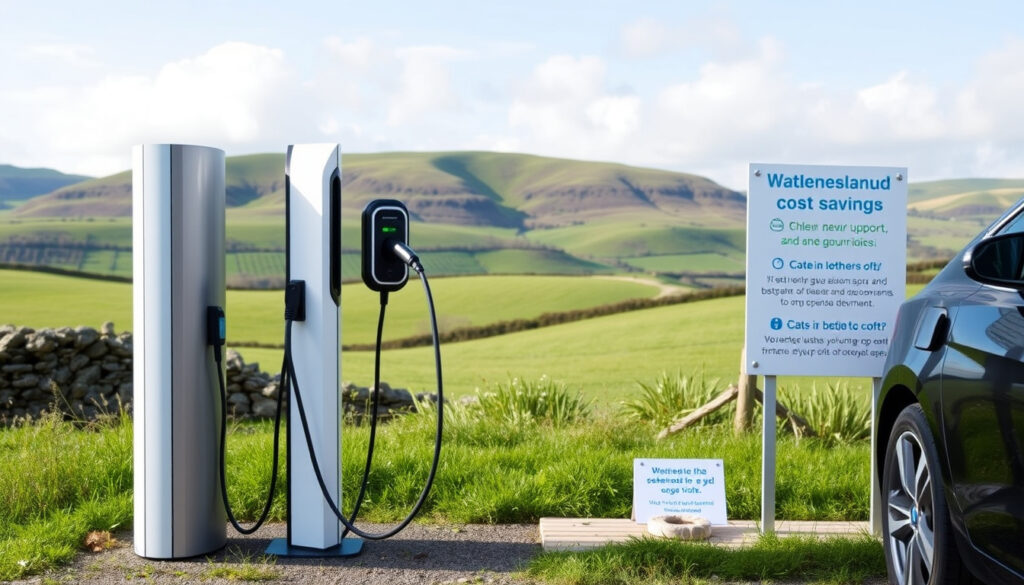
Electric Car Charger Ireland: Cost, Grants & Options
Anyone shopping for an electric car in Ireland quickly runs into the same question: what does it actually cost to charge at home, and how much of that can the government help with? Between the SEAI grant, the choice between a 3.6kW and a 7kW charger, and the lure of free top-ups at supermarkets, the picture can get blurry fast. This guide cuts through the noise with real figures, practical comparisons, and the key decisions every Irish EV owner faces.
Average cost of home EV charger in Ireland: €800–€1,200 ·
SEAI Home Charger Grant: €600 ·
Typical installation cost: €300–€500 ·
Public charge points in Ireland (ESB ecars): 1,600+ ·
Most common home charger power: 7kW
Quick snapshot
- SEAI grant covers €600 per charger (Solar Info (Irish solar & EV installer))
- Typical net cost after grant: €500–€1,100 (Energia (Irish energy supplier))
- ESB ecars operates over 1,600 public charge points nationwide (Solar Info (Irish solar & EV installer))
- IKEA Ireland’s current free charging policy — may have ended
- Long-term battery impact of daily 100% charging varies by EV model
- SEAI grant reduced from €600 to €300 in January 2024, remains at €300 for 2025 (Solar Info (Irish solar & EV installer))
- Grant application must be submitted within 6 months of charger installation (Solar Info (Irish solar & EV installer))
- Apply for SEAI Letter of Offer before installation (Energy Efficiency IE (Irish energy advisory))
- Check Lidl Plus app for free charging at local stores (Energy Efficiency IE (Irish energy advisory))
Five key fact points, one pattern: the SEAI grant slashes upfront costs by €300, but the real total depends on the charger type, install complexity, and whether you shop around.
| Item | Value |
|---|---|
| SEAI home charger grant | €300 per charger (as of 2025) |
| Public charge points (ESB ecars) | Over 1,600 across Ireland |
| Typical home charger power | 7kW (single‑phase) |
| Average installation time | 2–4 hours |
| Charger lifespan | 10–15 years |
How much does it cost to install an electric car charger in Ireland?
For an Irish homeowner, the total outlay for a home EV charger breaks down into two main chunks: the charger unit itself and the installation labour. A typical charger unit ranges from €500 to €1,000, while standard installation adds €300 to €500. That puts the pre-grant total at roughly €800 to €1,500.
After the SEAI grant — now €300 per charger since January 2024 — the net cost drops to between €500 and €1,200. Energia (Irish energy supplier) puts the typical post-grant range at €600–€1,200, while Electric Ireland (state-owned electricity supplier) offers a complete charger-plus-installation package for €1,199 after the grant (pre-grant total €1,499).
The €300 grant is half what it was in 2023 — the SEAI dropped it from €600. That still saves a meaningful slice, but Irish buyers now shoulder more of the upfront cost themselves.
Extra costs can creep in if your home needs a fuse board upgrade or a long cable run from the meter to the charging point. Electric Car Charger IE (Irish installation specialists) note that these factors can add several hundred euro to the final bill.
- Apply online at the SEAI website before installation, providing your MPRN and Eircode.
- Obtain a Letter of Offer from SEAI confirming eligibility.
- Have the charger installed by a Safe Electric registered electrician.
- Within 6 months of installation, submit the invoice, proof of payment, and the electrician’s certificate.
The implication: the headline €300 grant is valuable, but the total cost depends heavily on your home’s electrical setup and the charger brand you choose. Always get a site survey before committing.
The net cost after the €300 SEAI grant ranges from €500 to €1,200, but extra electrical work can push it higher. A site survey before installation is essential.
Should I get a 3.6 kW or 7kW charger?
This is the most common fork in the road for Irish EV buyers. The short answer: most households in Ireland install a 7kW charger, but 3.6kW can work if your daily mileage is low and you charge overnight.
Can I charge an EV from a 13A socket?
A standard 13A three-pin socket (the kind you plug a kettle into) can technically charge an EV, but it’s painfully slow — adding roughly 8 km of range per hour. For an overnight top-up of 8–10 hours, that gives you about 64–80 km. Adequate in a pinch, but not a regular solution. Regular use on a 13A socket also risks overheating the socket and wiring, especially in older Irish homes.
What are the charging speeds for different chargers?
Here’s how the three common options stack up:
| Charger type | Range added per hour | Best use |
|---|---|---|
| 13A socket | ~8 km | Emergency overnight only |
| 3.6kW wallbox | ~15 km | Low daily mileage (under 60 km/day) |
| 7kW wallbox | ~30–40 km | Most Irish households |
Energy Efficiency IE (Irish energy advisory) reports that a 7.4 kW Level 2 smart charger can fully replenish a typical EV battery in 4–8 hours, making it the practical gold standard for overnight charging at home. The 3.6kW unit takes roughly double that time.
The trade-off: a 7kW charger costs only marginally more than a 3.6kW one, but provides twice the speed. For anyone planning to keep their EV for more than two years, the 7kW unit pays for itself in saved time.
Can I charge my EV to 100% every night?
Technically yes, but battery experts advise against it as a daily habit. Most lithium-ion EV batteries prefer a daily charge limit of 80–90% because charging to 100% puts extra electrical stress on the cells, accelerating gradual capacity loss over time.
Should I top up my EV battery every day?
Topping up daily isn’t harmful by itself — the issue is the charging ceiling. If you plug in every night but stop at 80%, you’re actually treating the battery gently. Charging to 100% daily, conversely, edges the battery towards faster degradation. Manufacturers like Nissan and Tesla explicitly recommend staying at 80–90% for routine driving.
What is the best charging practice for battery health?
- Set the charger to stop at 80% or 90% for daily use
- Charge to 100% only when you need the full range for a long trip
- If you have a time-of-use electricity tariff, schedule charging for off-peak hours
The pattern: Irish EV owners who drive 50–80 km daily are best served by a 7kW charger set to 80% — they get a full useful range overnight without stressing the battery.
Can a normal electrician install an EV charger?
No — and this is a critical distinction. EV charger installation in Ireland must be performed by an electrician registered with Safe Electric (formerly RECI). The work must comply with Irish wiring regulations IS 10101, and the installer must provide a Certificate Number 3 and test record sheet for the SEAI grant application.
What qualifications are required?
To install an EV charger legally and to qualify for the SEAI grant, the electrician must be Safe Electric registered and competent in EV charger installation. Many ordinary electricians can do the job, but you must confirm their registration before hiring. The SEAI will not process a grant claim without a completed certificate from a Safe Electric registered professional.
Can I install an EV charger myself?
Self-installation is not permitted and will void any grant eligibility, charger warranty, and home insurance cover. The electrical work involves high-current circuits (typically 32A or 40A), and a mistake could cause fire or electrocution risk. Leave it to the pros.
Is a 13A socket adequate for occasional charging?
For a once-a-week emergency top-up, a 13A socket can work. For regular use, it’s both too slow and potentially unsafe. Electric Car Charger IE (Irish installation specialists) strongly discourage relying on a standard socket for routine EV charging.
The implication: budget for a certified electrician as a fixed cost. It’s not an area to cut corners, and the grant won’t pay out without the right paperwork.
Is EV charging free at Lidl?
Yes, at selected locations — but only if you use the Lidl Plus app. Lidl Ireland offers free EV charging at many stores, typically via 7kW or 22kW units, for the duration of your shopping visit. You need to verify availability on the app, as not every store has chargers.
Do Tesco offer free EV charging?
Tesco Ireland provides free charging at some stores, usually with 7kW units. Availability varies by location, and the chargers are often first-come, first-served. Check the Tesco store locator online before heading out.
Is Ikea EV charging still free?
IKEA Ireland previously offered free EV charging at its Ballymun store, but the current policy may have changed. As of early 2025, some reports suggest the free period may have ended or been restricted. Always call the store ahead of a visit.
What other retailers offer free EV charging in Ireland?
- Lidl (select stores, via Lidl Plus app)
- Tesco (some stores, 7kW units)
- ESB ecars fast chargers — most are pay-per-use
- IKEA Dublin — check before visiting
For a wider network, ESB ecars operates over 1,600 public charge points across Ireland, including fast and rapid chargers along major routes. Most of these are pay-as-you-go, with prices varying by speed and location.
For an Irish driver who does 20,000 km/year, relying solely on public charging can cost €600–€1,200 annually at pay rates. A home charger with night-rate electricity slashes that to €200–€400. The grant pays for itself in under two years.
The pattern: free charging at supermarkets is a nice bonus for weekly shopping, but it’s not a reliable primary charging strategy. A home charger remains the backbone of Irish EV ownership.
Frequently asked questions
Are electric cars safe for pacemakers?
Yes. Modern EVs produce electromagnetic fields well below international safety guidelines. The Irish Heart Foundation and international studies confirm no additional risk for pacemaker or ICD wearers in or near EVs.
Can someone with a heart device safely drive or ride in a hybrid or electric car?
Yes. Major cardiac device manufacturers have tested EVs and hybrids and found them safe. Standard precautions — keeping the device away from charging cables — apply as with any electrical equipment.
What is the best home EV charger for Ireland in 2025?
The best charger depends on your car and usage. Smart chargers from Zappi, EO, and Pod Point offer app control, solar integration, and SEAI eligibility. The Electric Ireland (state-owned electricity supplier) Zappi package is a popular bundled option.
Do I need a smart charger to qualify for the SEAI grant?
Yes, only SEAI-approved smart chargers qualify. The charger must be capable of remote communication and scheduling — basic dumb chargers are not eligible.
How do I apply for the SEAI home charger grant?
Apply online at the SEAI website before installation. You need your MPRN, Eircode, and a Letter of Offer from SEAI. After installation, submit the invoice, proof of payment, and the electrician’s certificate within 6 months.
Are there any additional grants for apartment dwellers?
The SEAI grant for home chargers is available to homeowners, landlords, and guest accommodation providers. For apartment residents with shared parking, individual grants may not apply; check with your management company for building-level solutions.
More related posts
 Normal Body Temperature Adults: Ranges, Fever & Low
 La Liga Matches 2026-2027: Schedule and Viewing Guide
 What Time is Katie Taylor Fight on Irish Time? Ring Walk Guide
 Social Welfare Payment Increase January 2026: €10 Boost
 Smart Home Device Security Risk: Vulnerabilities & Fixes
 How to Clean Stainless Steel Appliances Without Streaks
 Ozempic Dosing for Weight Loss: 0.25 mg to 2.0 mg
 How to Fix a Dishwasher: 5 Common Problems & DIY Solutions
