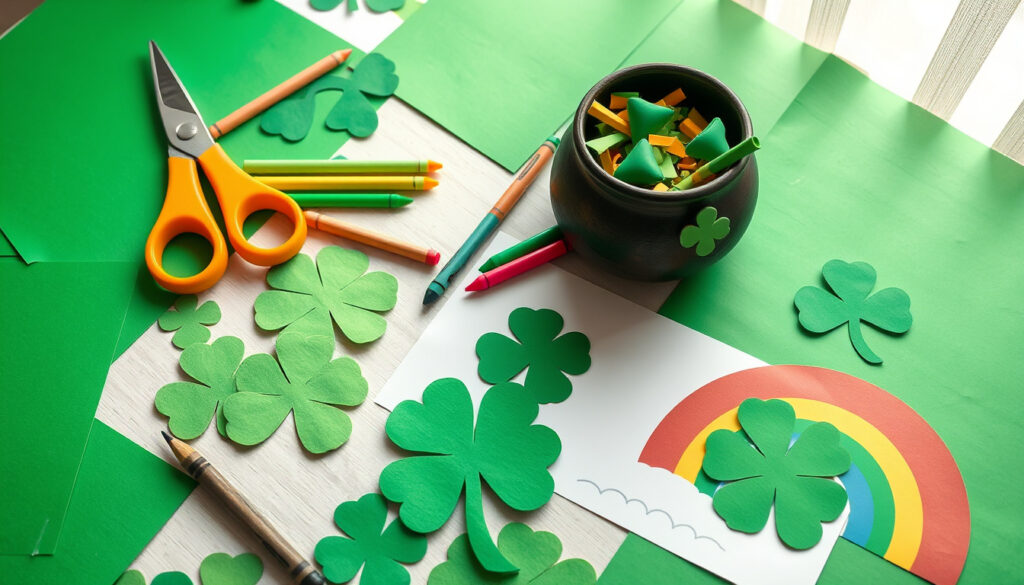
St Patrick’s Day Art for Kids: Easy Projects
A classroom full of children is always a little more exciting when art supplies come out—but add shamrocks and leprechauns, and you have something special. St. Patrick’s Day art for kids can go well beyond pre-printed coloring pages into real painting, collage, and printmaking techniques. Here, you’ll find projects that work for toddlers through tweens, with step-by-step directions that emphasize creativity over templates.
Date celebrated: March 17 ·
Traditional color: Green ·
Most common symbol: Shamrock ·
Typical materials: Paper, paint, glue, markers ·
Age range for projects: 3–12 years ·
Average project time: 15–30 minutes
Quick snapshot
- St. Patrick’s Day is celebrated annually on March 17 (Britannica)
- The shamrock is a national symbol of Ireland and St. Patrick’s Day (National Geographic Kids)
- Green is the most associated color (Time and Date)
- Exact origin of using leprechauns in children’s art projects
- Best paint type (washable vs. tempera) for very young children
- No timeline data applicable
- Try the step-by-step projects below
- Download and customize free printable templates
Many craft blogs offer ideas, but few teach actual art techniques. The projects here deliberately build fine-motor skills and color theory—so kids come away with more than a paper shamrock.
Six key facts frame every project, from date to materials.
| Fact | Value |
|---|---|
| Date celebrated | March 17 |
| Traditional color | Green |
| Most common symbol | Shamrock |
| Age range for projects | 3–12 years |
| Average project time | 15–30 minutes |
| Materials needed per project | 3–5 supplies |
The implication: These projects fit into a single class period or afternoon, and most households already own the supplies.
What are the best St Patrick’s Day art projects for kids?
Shamrock painting ideas
- Drip and splatter shamrock – Use a shamrock template and drip or splatter paint to create abstract designs. Best for ages 4+.
- Pointillist shamrock – Paint small dots inside a shamrock outline so the viewer’s eye blends the colors. Ages 5–8.
- Pop-art shamrock grid – Draw a grid over a shamrock and fill each square with a different color combination. Ages 6–12.
Leprechaun art projects
- Paper-plate leprechaun – Paint a paper plate orange, add a construction-paper hat and beard. Ages 3–5.
- Clothespin leprechaun puppet – Attach felt clothes and a tiny hat to a clothespin for a movable puppet (based on Education.com (teacher resource)). Ages 5–8.
- Leprechaun portrait collage – Cut out a face shape, then layer yarn hair and a paper hat onto a background. Ages 6–10.
A leprechaun-face craft built from construction paper and attached to white cardstock is a common preschool project.
What this means: Leprechaun crafts are more about fine-motor cutting and gluing than painting—great for younger kids who need scissor practice.
Rainbow crafts
- Tape-resist rainbow painting – Place painter’s tape in arch shapes, paint over, then pull off the tape. Ages 4–8.
- Coffee-filter rainbow – Color a coffee filter with markers, then spray with water to blend the colors. Ages 3–6.
- Rainbow-in-a-bag – Squirt paint inside a sealed zip-top bag and let kids mush it around—zero mess. Ages 2–4.
- Clothespin-and-pom-pom rainbow – Clip a pom-pom to a clothespin, dip into paint, and stamp rainbow arcs. Ages 3–6.
These rainbow activities are drawn from Little Bins for Little Hands (children’s craft resource) and ABCDee Learning (preschool activity blog).
Tape-resist takes more setup but teaches negative space; the bag method is fast and mess-free but yields abstract results—choose based on your patience level.
The implication: Parents and teachers must decide between setup time and lesson depth when picking rainbow projects for their group.
How can I make St Patrick’s Day art with simple supplies?
Materials list
Most projects use household items. Little Bins for Little Hands identifies the core set: paper or cardstock, washable paint, markers or crayons, cotton swabs or sponges, and printable templates. For puffy paint, mix equal parts white glue and shaving cream, then add food coloring.
Step-by-step painting
- Set up – Cover the table with newspaper. Lay out one paint color at a time for younger children.
- Choose technique – For a shamrock, either splatter paint from a brush or dot with cotton swabs.
- Add details – Once dry, outline with gold marker or glue on glitter.
- Display – Tape the finished piece to a window or string a gallery across the wall.
A shamrock printmaking activity uses a carved soap stamp; for classrooms, substitute a potato stamp to avoid soap issues.
Collage techniques
- Paper tear collage – Tear green construction paper into small pieces and glue them onto a shamrock outline.
- Fabric scrap rainbow – Cut strips of fabric in rainbow colors and glue them in an arch.
- Nature collage – Use leaves and grass (collected outside) to create a green-themed collage.
The catch: Collage is the easiest clean-up—no paint spills—and works across all ages.
Are there printable St Patrick’s Day art templates for kids?
Where to find templates
- Education.com offers free downloadable St. Patrick’s Day activity pages (Education.com).
- Crayola provides free coloring pages and cut-out shapes (Crayola (art supply brand)).
- Teachers Pay Teachers has templates created by educators, including leprechaun hats and rainbow outlines (TPT (teacher marketplace)).
- Little Bins for Little Hands says their quick printable projects are useful for last-minute celebrations and short art lesson times.
How to use templates
Print on cardstock for durability. For painting templates, cut out the shape first so children can paint inside the stencil. For coloring pages, let kids use crayons, markers, or watercolors.
Benefits of templates
- Reduce frustration for children who struggle with freehand drawing.
- Provide structure for group activities—everyone starts from the same base.
- Encourage customization: kids can decorate the template with their own patterns.
Why this matters: Templates don’t stifle creativity; they give a starting point. The creative choice comes in the colors, textures, and embellishments each child adds.
Confirmed facts
- St. Patrick’s Day is celebrated annually on March 17 (Britannica)
- The shamrock is a national symbol of Ireland and St. Patrick’s Day (National Geographic Kids)
- Green is the most associated color (Time and Date)
- Common supplies: paper, washable paint, markers, cotton swabs, templates (Little Bins for Little Hands)
- Puffy paint method: equal parts glue and shaving cream plus food coloring (ABCDee Learning)
What’s unclear
- Exact origin of using leprechauns in children’s art projects
- Best paint type (washable vs. tempera) for very young children – reportedly both work, but no authoritative study compares them
- Whether soap-carved stamps are safe for classroom use – Little Bins for Little Hands describes the technique but notes medium confidence
- Whether shamrock printmaking with soap stamps holds up for repeated classroom use
- Optimal paint type for clothespin-pom-pom stamping with toddlers – no formal comparison available
“St. Patrick’s Day art projects for kids include shamrock painting, rainbow art, and artist-inspired activities.”
Little Bins for Little Hands (children’s craft resource)
“Our paper-plate rainbow craft uses markers for rainbow colors and yellow cardstock for a treasure accent.”
ABCDee Learning (preschool activity blog)
“Coloring pages and cut-out shapes let kids decorate and display their work instantly.”
Crayola (art supply brand)
For parents and teachers planning a St. Patrick’s Day art session, the choice between painting, collage, or templates depends on your time and tolerance for mess. The implication is clear: if you want fine-motor development with zero stains, go with collage or the paint-in-a-bag method. If you want a gallery-worthy piece that teaches color theory, invest in the tape-resist rainbow. For the youngest artists, the clothespin-pom-pom technique builds grip strength while producing a cheerful rainbow. The trade-off is always between setup/cleanup time and the depth of the art lesson.
youtube.com, facebook.com, facebook.com, stepbysteppainting.net, instagram.com, youtube.com
Before starting these crafts, it helps to check the St. Patricks Day 2025 date and history so the timing lines up with classroom or family plans.
Frequently asked questions
What is the easiest St Patrick’s Day art for toddlers?
The rainbow-in-a-bag method: put paint inside a sealed bag and let kids squish it. Zero mess, fast, and still introduces color mixing.
Can I use washable paint for St Patrick’s Day art?
Yes—washable tempera is ideal for kids under 6. It cleans up with soap and water and works on paper, cardboard, and even windows.
How long does a typical St Patrick’s Day art project take?
Most projects take 15–30 minutes. Drying time adds another 10–15 minutes if you plan to layer colors.
Are there any St Patrick’s Day art ideas that use only crayons?
Yes: shamrock coloring pages, rainbow scratch art (using black crayon overlay), and tape-resist with crayon instead of paint all work well.
How to display kids’ St Patrick’s Day art?
Hang pieces on a window with removable tape, string a clothesline across a wall, or create a gallery on a magnetic board. Laminate keepsakes for the fridge.
What is a good St Patrick’s Day art project for a classroom?
A collaborative paper-chain rainbow: each child decorates one link, then the class assembles them into a giant rainbow arch. Teaches sharing and sequencing.
Can I combine St Patrick’s Day art with a lesson on Ireland?
Absolutely. While doing shamrock painting, read a short book about Irish folklore. Older kids can research the history of the shamrock and write a short paragraph to accompany their art.
More related posts
 Power City Near Me: Locations, Hours, Live Chat & Appliances
 How to Fix a Dishwasher: 5 Common Problems & DIY Solutions
 Early Stage Chicken Pox Rash Baby: Day 1 Signs Guide
 How to Reduce Sugar in Your Diet: Signs, Benefits & Tips
 Cast of Countdown American TV Series: Full List & Cancellation
 5 Day Weather Forecast Ireland: Reliable & Official Sources
 Ireland Heatwave June Forecast: Will Summer 2026 Be Hot
 Sugar Rush 1000 Demo: Play Free with x1024 Multipliers
