Early Stage Chicken Pox Rash Baby: Day 1 Signs Guide
You’ve just spotted a few small red bumps on your baby’s face, and your mind jumps to chickenpox. It’s a moment every parent dreads, but knowing exactly what to look for in those first 24 hours can make all the difference.
Incubation period: 10–21 days · Contagious window: 2 days before rash to when all blisters crusted (5–7 days) · Typical onset symptoms: Fever, fatigue, loss of appetite before rash · Rash duration: 3 stages – spots, blisters, scabs – over about 5–7 days · Most common complication in babies: Secondary bacterial skin infection
Quick snapshot
- Exact number of babies who develop complications varies by study and region (CDC clinical overview)
- Long-term effectiveness of varicella vaccine in infants under 12 months has limited studies (Children’s Hospital of Philadelphia)
- Incubation: 10–21 days after exposure, then fever/tiredness 1–2 days before rash (CDC)
- Rash starts on face/trunk and spreads; new spots appear for 3–5 days (Children’s Hospital of Philadelphia)
- Scabs form day 6–7; baby no longer contagious once all scabs are dry (Mayo Clinic)
- Most babies recover at home; antivirals (aciclovir) reserved for high-risk cases if started early (Pregnancy Birth and Baby)
- Watch for dehydration, breathing trouble, or signs of skin infection (Nemours KidsHealth)
Five key facts every parent should have at hand.
| Fact | Value |
|---|---|
| Incubation period | 10–21 days |
| Contagious period | 2 days before rash till all blisters crusted |
| Most common age for chickenpox | Under 10 years (peak 5–9 years) |
| Chickenpox in babies under 3 months | Higher risk – immediate medical assessment needed |
| Treatment for severe cases | Antiviral (aciclovir) within 24 hours of rash |
What are the first signs of chickenpox in babies?
Early flu-like symptoms before the rash
Before any spots appear, a baby may develop a fever, become unusually tired, and lose interest in feeding. The CDC (U.S. public health agency) notes that these general symptoms—headache, mild cough, or runny nose—can begin 1 to 2 days before the rash. Some babies grow irritable and clingy, a clue that something is off. In a few cases, according to Superdrug Health Clinic (UK pharmacy chain), the rash may appear first with no warning signs at all.
Understanding the rash onset timeline
- The rash typically begins on the face, chest, or back, then spreads outward (Medical News Today).
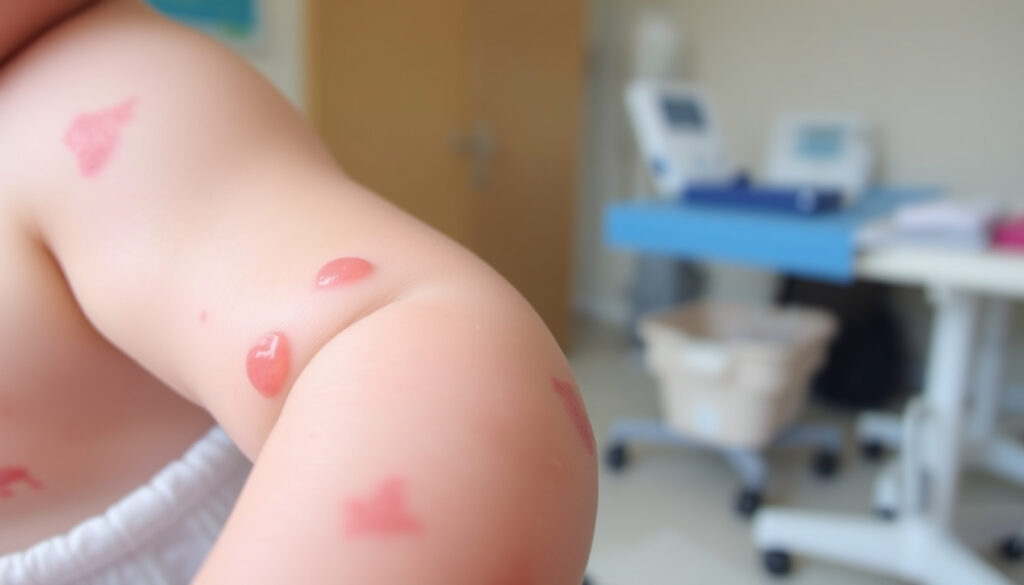
- The first lesions are small red bumps (macules), which turn into raised papules within hours (SkinSight, dermatology resource).
- Within a day, these become fluid-filled blisters (vesicles) that may look like “dewdrops on a rose petal” (CDC clinical description).
The pattern: multiple stages of spots, blisters, and scabs all present at the same time. That’s a hallmark of chickenpox, unlike most other rashes.
Parents who spot a fever one day and red bumps the next should not wait for full-blown blisters to suspect chickenpox. The early flu-like phase is your first signal—act on it.
The implication: early recognition depends on connecting fever with the first red spots, not waiting for blisters.
What does day 1 of chickenpox look like?
Appearance of the first spots
On day 1, the rash shows up as small red or pink spots, often on the face, scalp, or upper chest. They can look like pimples or insect bites, according to Nemours KidsHealth (children’s health resource). Within hours, those spots develop a tiny fluid-filled center—a vesicle. The Children’s Hospital of Philadelphia describes the rash initially as “red bumps” that evolve rapidly.
Progression within the first 24 hours
- New spots keep appearing in waves over 2 to 4 days (Nemours KidsHealth).
- The rash may be red or the same color as the surrounding skin (Medical News Today).
- Babies often become increasingly itchy, though very young infants may not be able to scratch (Pregnancy Birth and Baby, Australian health service).
“The telltale sign of chickenpox is a crusty, itchy rash that usually starts on the face, neck, or trunk.”
The implication: if you see clusters of red bumps on your baby’s face this morning, expect them to turn into blisters by evening. That’s the typical day-1 trajectory.
What can be mistaken for chicken pox rash?
Hand, foot, and mouth disease
HFMD produces blisters, but they cluster on the palms, soles, and inside the mouth—unlike chickenpox which spreads across the trunk. CDC notes that chickenpox lesions are also itchy, whereas HFMD blisters are often painful but not especially itchy.
Impetigo, scabies, heat rash, and allergies
- Impetigo: honey-colored crusts, less widespread, usually around mouth or nose (Nemours KidsHealth).
- Scabies: small curved tracks on skin, intense itching at night, no blisters.
- Heat rash: tiny red bumps in sweaty areas (neck, diaper area), not vesicular.
- Allergic hives: raised welts that come and go, never form blisters.
- Insect bites: individual itchy lumps, usually not in clusters or on trunk.
The catch: early chickenpox can look exactly like a cluster of mosquito bites. But if you see multiple stages (some flat, some raised, some blistered) on the same area of skin, it’s almost certainly varicella.
Misidentifying the rash can delay proper care. A baby with chickenpox needs different treatment—and stricter isolation—than one with heat rash or HFMD. Getting it right on day 1 reduces anxiety and stops spread.
Four common look-alikes, one pattern: chickenpox has simultaneous stages; the others do not.
| Rash type | Key features | How to tell apart |
|---|---|---|
| Hand, foot, and mouth disease | Blisters on palms, soles, mouth; often fever | No trunk involvement, painful not itchy |
| Impetigo | Honey-colored crusts around mouth/nose | Not widespread, no blisters on face/chest |
| Heat rash | Fine red bumps in neck, armpits, diaper area | Non-fluid-filled, disappears with cooling |
| Scabies | Small tracks or burrows, intense nighttime itch | No blisters, burrows visible on hands/feet |
The pattern: if the rash has blisters on the trunk and appears in multiple stages, it’s unlikely to be heat rash or scabies.
Is medication safe for chickenpox? (Calpol and Piriton)
Using paracetamol safely in babies
Superdrug Health Clinic advises that Calpol (paracetamol) can reduce fever and discomfort in babies over 2 months, provided the correct dose is used. However, ibuprofen should be avoided because it may increase the risk of secondary skin infections in chickenpox. Aspirin is strictly forbidden in children due to the risk of Reye’s syndrome (CDC).
Antihistamine use in babies: Piriton
Piriton (chlorphenamine) can be used to reduce itching in babies over 1 year, but only under medical advice. For infants under 12 months, always consult a doctor first—drowsy antihistamines may help a baby sleep through the itch, but they are not a treatment for the virus itself (Nemours KidsHealth).
“The chickenpox rash can appear suddenly, 1 to 2 days after developing early flu-like symptoms.”
The trade-off: medication can soothe symptoms, but the wrong choice (ibuprofen, aspirin) or dosing errors can put a baby at risk. Always check with your GP before giving any drug for chickenpox.
What if my 2 month old gets chickenpox?
Immediate medical steps
Newborns under 3 months are at higher risk for severe illness, including pneumonia and encephalitis, according to CDC clinical overview. Contact your GP or paediatrician immediately if a baby under 3 months is suspected of having chickenpox. Hospitalisation may be needed for antiviral treatment with aciclovir, which is most effective when given within 24 hours of the rash onset (Pregnancy Birth and Baby).
Possible complications in very young infants
- Dehydration (dry nappy, no tears) – watch fluid intake (Nemours KidsHealth).
- Difficulty breathing or rapid breathing – seek emergency care.
- Extreme drowsiness or confusion – possible encephalitis signal.
- Scabs that become red, hot, weeping – sign of secondary bacterial infection (Mayo Clinic).
A 2-month-old with chickenpox faces a real risk of serious complications. The parent’s job is not self-treatment but early medical assessment. Delaying by even 12 hours can reduce the window for antiviral effectiveness.
The implication: for babies under 3 months, the decision to call a GP should be immediate, not wait-and-see.
What to do if your baby has chickenpox: a step-by-step guide
- Confirm the diagnosis – consult your GP, especially if baby is under 6 months (CDC).
- Keep baby home – chickenpox is contagious from 2 days before rash until all blisters are crusted (usually 5–7 days) (Mayo Clinic).
- Relieve fever safely – paracetamol (Calpol) if baby is over 2 months; avoid ibuprofen (Superdrug Health Clinic).
- Soothe itching – cool baths, loose cotton clothing, calamine lotion (consult doctor for babies under 1 year) (Pregnancy Birth and Baby).
- Monitor for red flags – dehydration, breathing issues, drowsiness, infected scabs – and seek medical help immediately if any appear (Nemours KidsHealth).
Timeline of chickenpox in babies
From exposure to full recovery, here’s the typical progression.
| Period | Event |
|---|---|
| Day 0 (exposure) | Baby exposed to chickenpox virus |
| Day 10–21 (incubation) | No symptoms yet |
| Day 1–2 before rash | Fever, tiredness, loss of appetite |
| Rash day 1 | Small red spots appear on face/trunk |
| Rash day 2 | Spots become fluid-filled blisters (vesicles) |
| Rash day 3–5 | Blisters crust over, new spots may continue |
| Rash day 6–7 | All scabs dry and fall off; baby no longer contagious |
The pattern: the contagious window starts before you even see a spot. That’s why isolation based on exposure history matters.
Clarity: what’s confirmed vs. what’s unclear
Confirmed facts
- Chickenpox is highly contagious and spreads via airborne droplets or direct contact (CDC).
- The rash goes through three distinct stages: spots, blisters, scabs (CDC).
- Paracetamol (Calpol) can reduce fever; ibuprofen may increase skin infection risk (Superdrug Health Clinic).
- Babies under 3 months should see a doctor immediately if chickenpox is suspected (Pregnancy Birth and Baby).
- Antiviral treatment (aciclovir) is used in high-risk cases if given early (CDC clinical overview).
What’s unclear
- Exact number of babies who develop complications varies by study and region (CDC clinical overview).
- Long-term effectiveness of varicella vaccine in infants under 12 months has limited studies (Children’s Hospital of Philadelphia).
- Optimal timing for antiviral therapy in very young infants remains debated (Mayo Clinic).
- Risk of febrile seizures from chickenpox fever in babies under 1 year may be higher than generally reported (Nemours KidsHealth).
- Threshold for hospitalising otherwise healthy babies between 3 and 12 months is not standardized across guidelines.
Expert perspectives on chickenpox in babies
“The main symptom of chickenpox is an itchy, spotty rash. It happens in 3 stages – small spots appear, become blisters, then become scabs.”
— CDC (U.S. public health agency)
“The chickenpox rash can appear suddenly, 1 to 2 days after developing early flu-like symptoms.”
— Superdrug Health Clinic (UK pharmacy chain)
“The telltale sign of chickenpox is a crusty, itchy rash that usually starts on the face, neck, or trunk.”
— Medical News Today
Chickenpox is rarely dangerous for an older baby with a healthy immune system, but the first year—especially the first three months—demands vigilance. For parents of babies under 3 months, the choice is clear: call your GP immediately, or risk serious complications that could have been prevented with early antiviral treatment.
Related reading: Can You Take Ibuprofen with Paracetamol? · Irish Mammies: What to Expect – Traditions & Postpartum Tips
Frequently asked questions
How long does chickenpox rash last in babies?
The rash typically lasts 5 to 10 days. Spots appear over 3–5 days, then scab over and fall off by day 7–10 (Mayo Clinic).
Can you bathe a baby with chickenpox?
Yes, cool baths with baking soda or colloidal oatmeal can soothe itching. Pat dry—don’t rub—to avoid bursting blisters (Pregnancy Birth and Baby).
Is chickenpox dangerous for babies under 6 months?
Yes, especially under 3 months. Severe complications include pneumonia, encephalitis, and bacterial skin infections. Immediate medical assessment is essential (CDC).
How to soothe chickenpox itching in babies?
Keep nails short, dress in loose cotton, use calamine lotion (after GP approval), and consider a drowsy antihistamine if baby is over 1 year and doctor recommends it (Nemours KidsHealth).
What cream is safe for chickenpox rash on babies?
Calamine lotion is commonly used for itch relief. Avoid steroid creams and any product containing hydrocortisone, as they can worsen varicella (Superdrug Health Clinic).
Can a 2 month old get chickenpox from siblings?
Yes. Chickenpox is highly contagious and spreads through respiratory droplets or direct contact with blisters. If an older sibling has chickenpox, a 2-month-old should be kept separate and the GP contacted (CDC).
Does chickenpox leave scars on babies?
Most spots heal without scarring if not scratched. Secondary infection from scratching increases scar risk. Keep nails trimmed and consider cotton mittens for newborns (Mayo Clinic).
Can I prevent chickenpox in my baby if exposed?
Varicella vaccine given within 3–5 days of exposure can prevent or reduce severity in children 12 months and older. For infants under 12 months, passive immunity from maternal vaccines or immunoglobulin may be considered—ask your doctor (Children’s Hospital of Philadelphia).
More related posts
 A Few Good Men: True Story, Iconic Line & Worth Watching
 Tesco Killarney Opening Hours: Superstore & Express
 The North Face Dublin: Stores, Prices & Why It’s So Expensive
 Cafes in Reykjavík Iceland: Best Coffee & Bakeries
 Best Films on Netflix Ireland Right Now: Top 10 + Picks
 Aura Navan Pool Timetable – Sunday & Weekday Hours
 Utah Jazz vs Lakers Match Player Stats: 131-107 Result
 What Is Dividend Yield? Definition, Formula, and Examples
